

You picked a good weekend to come.
We’ve had a cold, damp spring. But this weekend, the light is doing that thing it does in May, or July, or early October, where it angles across the water at a height that makes you feel like you’ve stepped into something that was made specifically for you. The mountains are there. The air smells like pine and cold water even when the temperature is warm(ish). Someone’s boat is moving slow across the far side of the lake, and the wake is catching the sun in a way that doesn’t feel real.
You’ve been thinking about this for a while. And this weekend, you’re thinking about it more concretely.
We want to talk to you about that. Not to talk you into anything. Not to talk you out of anything either. But because there’s a conversation worth having before you get too far down the road, and it’s not one most people have with you early enough.
Here it is: the Lakes Region isn’t a summer. It’s a year. And whether that year, in its entirety, is right for you is the actual question.
What You’re Seeing Right Now Is Real
We want to be clear about that first, because we’re not about to spend this entire piece warning you away from something we love. What you’re feeling this weekend is not a trick. The lake is that beautiful. The pace does shift when you cross the state line. The quality of life available here genuinely is what it looks like from where you’re standing.
But you’re standing in it on a finally-warm Sunday in May. Maybe you’ve also stood here on a day in July when the sun hung in the sky for what felt like days or during peak foliage when every hillside looks like someone dialed up the saturation. In any case, it’s likely the life you’re imagining is being built on the evidence of one season, maybe two.
The people who thrive here knew how the full year lands before they arrived, or they learned it fast and decided it was worth it anyway. The people who struggle often say some version of the same thing: it wasn’t what I expected. Not the pace. The winter. The quiet. The trade-offs that don’t feel like trade-offs in May or July or October.
So here is what we actually know about the year, all of it, because you deserve to decide with the whole picture.
Mud Season Is Real and It Will Test You
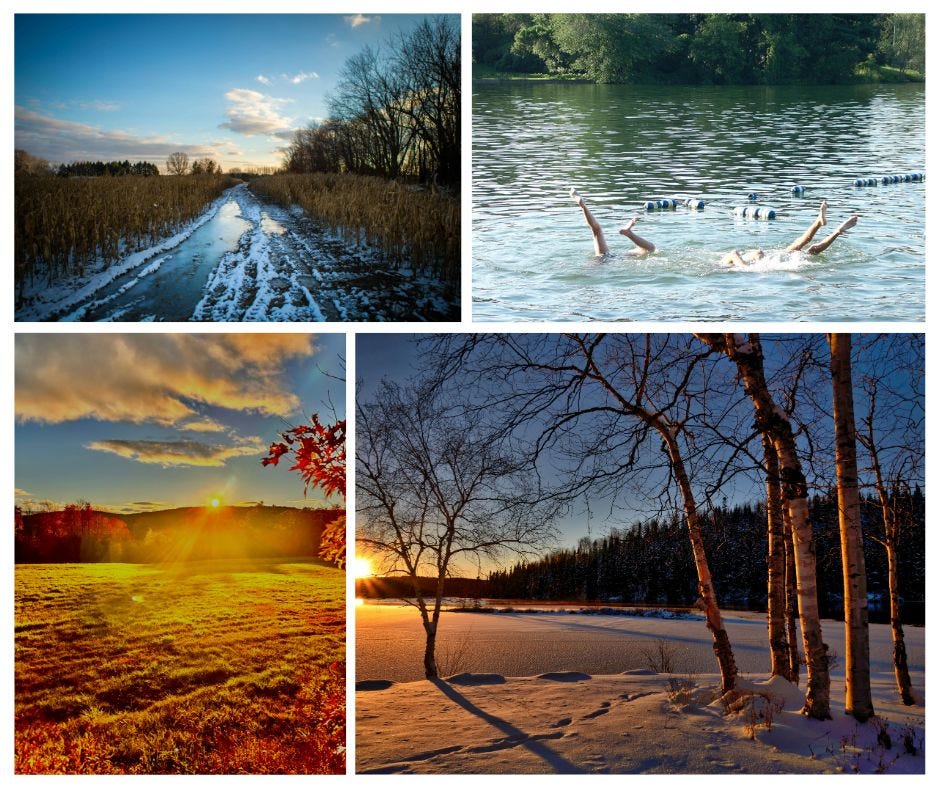
Late March into April is mud season. Not metaphorical lotuses growing out of mud as personal development. Physical, actual, your-car-is-stuck-and-also-your-driveway-is-impassable mud. The frost comes out of the ground and the unpaved roads become soft and the fields look like they haven’t decided yet whether they will ever green again or not. The snow is gone from most places but it’s still hanging on in the shaded hollows. The peepers are starting at night and the songbirds are making themselves known in the mornings and everything smells like something waking up from a long sleep.
It’s not all unpleasant. Honestly, there’s something we’ve come to love about mud season. It feels honest. The Lakes Region in April is not performing for you.

The people who love it here know how to plan for it. They don’t pretend it isn’t happening. They order a little ahead. They know which shortcuts have to wait for May. They’ve bought unlimited use passes for the car wash.
Summer Is the Best of It. Also the Busiest.
Summer here is what it looks like from the outside. The water is warm enough to swim by July. The farmers markets are running. The days are long in the way that northern summers are long, where it’s still light at 8:30 and you eat dinner on the porch and nobody wants to go inside. The lakes are alive. The trails are open. There is a specific quality to a July morning on the water before the boat traffic starts that we have never found a way to adequately describe to someone who hasn’t felt it. You just have to be there.
But summer is also the season when the region becomes a different place. The roads back up. You stop going to your favorite restaurant because its too crowded and wait is too long. The lakes, especially Winnipesaukee, are busy by the Fourth of July in a way that can surprise people who visited in May and thought they understood what they were getting. If you’re imagining a quiet life on the water, summer will ask you to redefine quiet. The neighbors whose houses were dark all winter are back. The boat launches have lines on weekend mornings. The town you loved in April is now sharing itself with a lot of people who drove up from Massachusetts for the week.
None of this is bad. Some of it is wonderful. But it’s worth knowing that the Lakes Region in summer isn’t a hidden secret. It’s a known quantity, and it acts like one.
The Tuesday in November Test
Here’s the one that matters most.
Imagine a Tuesday in the second week of November. The foliage is completely over. The summer people are gone, their houses dark and buttoned up until Memorial Day. The lake is the color of pewter. It’s getting dark earlier every day. You have nowhere to be and no one is coming over and the wind is doing something unpleasant in the trees, which are naked.
That Tuesday is coming. Every year, it comes.
The question is not whether you can survive it, because you can. The question is whether you can be in that Tuesday and feel, somewhere underneath the brown and the grey and the quiet and the early dark, something that resembles peace. Maybe even something that resembles pleasure.
Not every person can. And that’s not a character flaw. It’s information. Some people are genuinely built for seasons and silence and the particular enforced introspection that comes from living through a northern winter. Some people find out, somewhere around the second February, that they are not, and they needed to find that out.
The people who love it here most have almost all had a version of that Tuesday. They’ve sat in it. And somewhere in it, usually not dramatically, usually just quietly, they realized: I still want to be here. I’m cold and the sun set two hours ago and I have to drive 45 minutes to get decent Indian food, and I still want to be here.
That’s the test. Not the July weekend. The Tuesday in November.
What Winter Actually Is
The darkness is a real thing. By December you’re losing the light before 4:30, and dark in the Lakes Region is different from dark in a city or a suburb. There are no street lights on most roads. If you live lakeside, the reflection off the water on a clear night is extraordinary, the stars are genuinely astonishing, but on an overcast night in January you are in something close to actual darkness when you walk to your car.
You adjust. Almost everyone does. And then something strange happens: you start to like it. The cozy evenings with a couple of close friends. The fireplace that earns its keep. The way a snowstorm that would paralyze a city becomes, up here, just the day being what the day is. You get wood. You get a good plow guy. You learn which neighbors will check on you and which ones you’ll check on.
There is a particular quality of life in winter here that people don’t tell you about because it’s hard to explain. The region empties of those who don’t love winter, mostly, and the people who are left have chosen to be fully here. There’s a shorthand that develops between year-rounders that is different from summer friendships. You’ve been through something together. That matters.
But winter requires preparation, both practical and psychological. You need a plan for when the power goes out, because it will. You need someone who can help if you get stuck. You need, more than anything, to have made peace with the idea that January is not an inconvenience to be survived. It’s part of where you live. It belongs to the year the same way August does.
Belonging, Below Zero

It’s 5:30 AM and still darker than dark outside. This time of year, we don’t see the sun until about 7. But the dogs don’t care. Their internal alarm clock tells them it’s time to go out and patrol, so that means it’s time to get up. It’s snowing. Again. And it’s beautiful, the birches popping silver in the light of the moon that hasn’t yet set. In summ…
What the People Who Love It Most Have In Common
We’ve worked with a lot of people who’ve made this move. And the ones who are thriving here, genuinely thriving, not just stopping by for a few years, have something in common that isn’t about personality type or outdoor enthusiasm or how many winters they’ve seen before.
They decided to be here. Not just in July. In all of it.
They went through a hard February, like this past one. Maybe the one where the cold didn’t break for three weeks and the driveway was a sheet of ice and your boiler went out and you had to beg your guy to come by and fix it right away and the isolation felt, for a few days, a little heavier than they expected.
And on the other side of it, they felt glad. Still here. Still glad.
Some of them felt glad in a surprised way, like they’d passed a test they didn’t know they were taking. Some of them had suspected they’d feel that way and were just confirming it. Some of them, honestly, had harder days than they expected, and then spring came and the ice went out and the peepers started and they thought: okay. We’re doing this. Still.
That’s what belonging looks like here. Not a perfect love story. A chosen one. You know what it gives, and what it sometimes takes. You keep choosing it.
So Where Are You, Actually?
If you’re visiting this weekend and something in this piece is landing in a clarifying way, one direction or another, that’s exactly the right response. This place deserves a real decision, not a vacation-version one. So does your life.
If you’re thinking through whether the full year here is right for you, we put together a field guide that covers what the listing won’t tell you: seasonal rhythms, town personalities, the real cost of year-round life in the Lakes Region.
Here’s to knowing.
🧭 Jenn & Andrea
Keys to the Lakes
