

Part 3 of a series on the history of the Lakes Region.
Piece two of our history series ended on paper: charters handed to men who had never laid eyes on the land. A link to that article is below in case you missed it or want to go back and refresh your memory.
Eventually somebody had to go and look.
The first permanent settlers reached Wolfeboro in 1768. That same year, a man started clearing land on the shore of what everyone then called Smith’s Pond. He was in his early thirties, born in Portsmouth, governor of the province, and nephew to the Benning Wentworth who signed the charter. He was also one of the original grantees, which made him a rarity: a name on the paper who actually showed up.
John Wentworth built a house there. By most accounts it was enormous, though nobody left plans or a sketch, and it burned in 1820, a couple of decades before photography could have helped. The closest thing to an eyewitness account I have found is a letter from his wife, written in October 1770, the autumn the place was going up around her. She was alone, she told a friend in Portsmouth, and wished someone would come play billiards. The governor was so busy giving directions to his workmen that she had “almost turned hermit.” The great dancing room was nearly finished. She wanted it understood that she did not prefer a grove to a ballroom.
She seems a formidable woman; and one who likely preferred the city to the countryside.
She also mentioned, in passing, the thing that matters most for our story today. She dreaded the trip back to town because “the roads are so bad.”

A house in the woods is a retreat…but only if you can actually reach it. Wentworth lived in Portsmouth, then the seat of government on behalf of the King. Portsmouth, now only about a 35 minute drive, was a long way off by 1770 standards, and he was not going to move a household, a coach, and a ballroom’s worth of guests painstakingly along cow paths through the woods. So he ordered a road, running from Portsmouth up through Rochester toward Wolfeboro. The Wolfeboro Historical Society dates it to 1769, a year after the first permanent settlers in Wolfeboro. The towns along the way were expected to supply the labor, which is where, by the telling of the Rochester historian who has made a study of it, the trouble started.
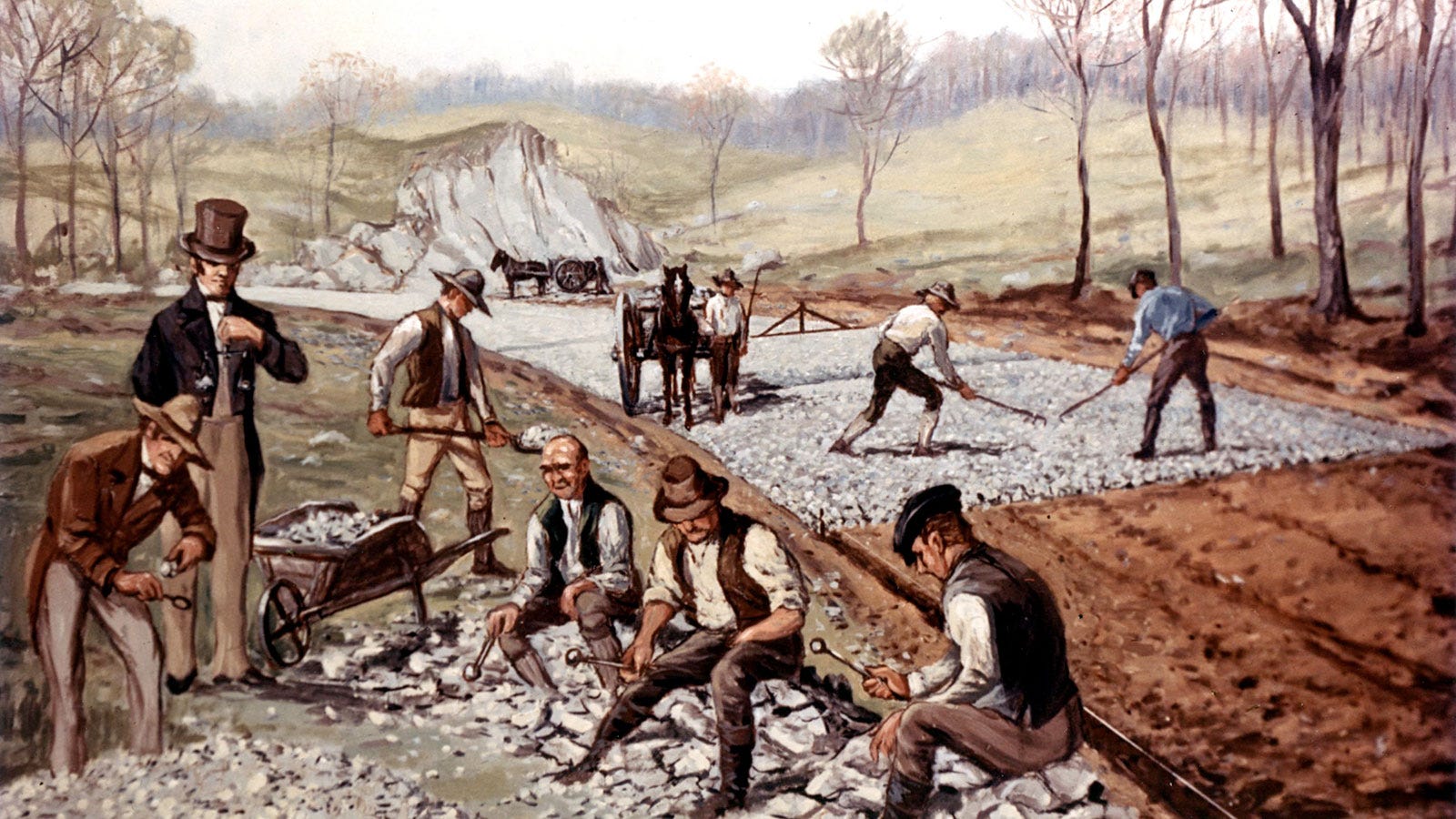
It helps to know what building a road meant then. Jeremy Belknap, a friend of Wentworth’s who published his history of New Hampshire in 1792, described the method. Surveyors blazed trees and marked each mile. Axemen cleared a strip three rods wide, about fifty feet, and cut the stumps low. Swampy ground got laid over with logs. Small streams were crossed on beaver dams, which Belknap judged firm and convenient. It was, in other words, a road built by neighbors with axes and oxen, and the neighbors had their own farms.
That July, the New Hampshire Gazette reported that His Excellency had set out for his country seat on Winnipesaukee, and that his lady would follow the next week.
The road he had built, as it happens, runs past my front door.
My house is the Major Jonathan Gilman House, on Governor’s Road in what is now Wakefield. The deed is dated 1769, so the house had just been finished when the road came through and the land it sat on, then several hundred acres, had been granted by the King via Wentworth for services performed by the Gilman family — namely settling the interior. The place was called East Town then, and this was something like the third house built there; the first two belonging to John’s father and brother. The story that goes with it is that the road was laid out to pass the house, and that it served as a staging stop, an inn of sorts, for some of the first travelers. I believe the Governor and his wife stayed here on some of those trips. I can’t prove it. If they did, Lady Frances may have shared her opinions about the roads under my roof, and likely complained about the soup in front of the same fire I now use as ambiance rather than for cooking.
Wentworth himself would sign off on the town’s incorporation as Wakefield five years later, on a petition from the people who lived there, so the man who built the road eventually made the place it ran through official. I keep wondering what all of this looked like from the front step of someone who was staying; the first version of the year-rounder, if you will.
I can tell you some of it, where the historical record, or speculation by historians has provided ideas. In East Town, the first settlers had come in 1766, and the frame of the first meetinghouse went up in 1771 near the outlet of what the records call Lovell’s Pond. Over in Wolfeboro, nine people started farms in the southwest corner of town in 1768, the same year Wentworth began clearing. There were no roads leading in, and most travel ran over the lake. Later county histories say meal came in on men’s shoulders from Gilmanton and Rochester but neither of those towns existed yet, so I imagine Jon and his family were bringing what they couldn’t raise or barter for locally from Portsmouth. They likely would have appreciated the road a bit more than Lady Frances did. The early settlers were poor, it says, and their main capital was muscle.
Into that came a payroll. For three years Wentworth kept a large crew clearing land, planting orchards, laying stone walls, and building a house, with materials hauled by cart and boat from Portsmouth. The bricks for the chimneys are said to have been made at the foot of the falls on Smith’s River. The same county history says the town considered him a benefactor who paid well. It also says that two enslaved people were left behind on his estate when he fled revolutionaries. A later town historian adds that most of the laborers had no plan to stay, and that the estate was close to insolvent, with spending very high and income small. A wage is still a wage when the man paying it is overextended, at least until he leaves.
Then came the guests. In another letter, Lady Frances thanked a friend in Portsmouth for arranging that a house on the road, one the friend herself had lodged at, be made ready for the Wentworths’ return. She wanted it only “a little clean,” she said, because “elegance is not to be found in the country.” I don’t know whose house that was, and I’m not claiming it was mine (though it could have been). But someone kept it, someone made it ready, and I would bet that whoever it was heard some version of that opinion before the visit ended.
What did it mean to the people who stayed? I can only guess, and my guess is that it meant different things in different kitchens. For a family with a spare room, an ox team, or a field of hay, a household that wanted lodging and feed was a market that had not existed the year before. For a town asked to supply labor for a road, it meant owing days of work to a project that mostly served someone else’s route. For anyone who watched the coach go by, it may have meant very little, or it may have meant noticing for the first time that other people thought of this as a place to visit. I doubt any of them thought they were watching the start of anything. Lady Frances herself wrote that winter roads were too uncertain to plan around. The people who lived here had no choice but to plan around them, just like today.
One more thing complicates the tidy version. Seasonal arrival was not only something the wealthy did. Henry Rust, a Portsmouth shipmaster, cleared a lot in Wolfeboro in 1768 with his two sons, farming through the warm months and going back to Portsmouth for winter. One winter the boys, twelve and fourteen, stayed on alone in a log camp with an old horse. His wife did not move up until 1773, in an ox-cart, reluctantly. Rust went on to become the town’s leading citizen. So the line between summer person and settler, at the start, was blurrier than you might assume. It seems to have been less about when you arrived than about whether you made it through a winter and kept going. Again, not unlike today.
The towns were not all thrilled. When Wentworth pushed the road on toward Dartmouth College in 1771, the province appropriated almost nothing to survey sixty or seventy miles of it, and a surveyor’s petition says two lakeside towns ignored the notice to clear their sections. In August 1772 the college’s president wrote to say it was doubtful the road was passable. Wentworth went anyway, with a party of Portsmouth gentlemen. A Dartmouth librarian who spent years tracing the route in the 1920s concluded that it probably never carried wheels before the Revolution, and that it was well suited to the governor’s convenience and not much else.
I would like to tell you the road changed everything. The record is more modest than that. But Brookfield’s own town history credits the road with bringing its first families, who settled along it, and while that account dates the road earlier than the rest of the record does, I believe the instinct behind it. Nobody builds a road for one man and keeps it private. Once it exists, it belongs to whoever uses it.
Here is what happened next. Wentworth left in 1775, when the province stopped being safe for a royal governor, and he never came back. The state seized the estate and sold it. His house stood another forty-five years and then burned. The road stayed, in pieces. Parts of it are still Governors Road in Rochester and Milton and Sanbornville, and the Governor Wentworth Highway name is on the sign along Route 109 today. The librarian found that after the Revolution, a road survived where it matched what the neighbors needed. Where nobody lived beside it, it went back to brush.
So that is the pattern, as far as I can read it. He said as much himself. In an April 1768 letter he wrote that a country seat was not his only aim, and that he hoped others would follow his example. Money arrives for the season. It builds what it needs to be comfortable. The place rearranges itself, a little, around the result. Wolfeboro’s motto calls it the oldest summer resort in America, and that claim comes down to this one man and this one house.
Not a villain, though. Not a saint either. By every account he loved the woods, he was born here, and he wanted Wolfeboro to be more than a summer address. He once told the Assembly that his salary would not stretch to living in town, which means he described his summer estate to them as a budget measure. He had a long driveway and a lot of neighbors he had not met yet.
Some of you reading this are deciding right now how much of the year to be here. I don’t think that is a moral question. Henry Rust started with summers, too. But it has been a question since 1768, and Wentworth’s road suggests a quiet answer: a place keeps what its people keep open.
If this made you think of someone who loves this region, send it their way.
Here’s to whoever plows the road in March. 🧭
— Jenn
