We’re officially in shoulder season up here again. With Labor Day in the rear view, from now to mid-October, weekends will remind us of summer energy while weekdays call ahead to when it will be locals season again. And, the reality is that what’s to come is one of the most serious seasons for those thinking about relocating here permanently, as year round residents. With that in mind, I want to look ahead to what these places are like in March, when even my romanticism about the place tends to wane; because if you’re thinking about picking a place up here, you might love it in July, its important you like it in September…and you better be able to tolerate it in March.
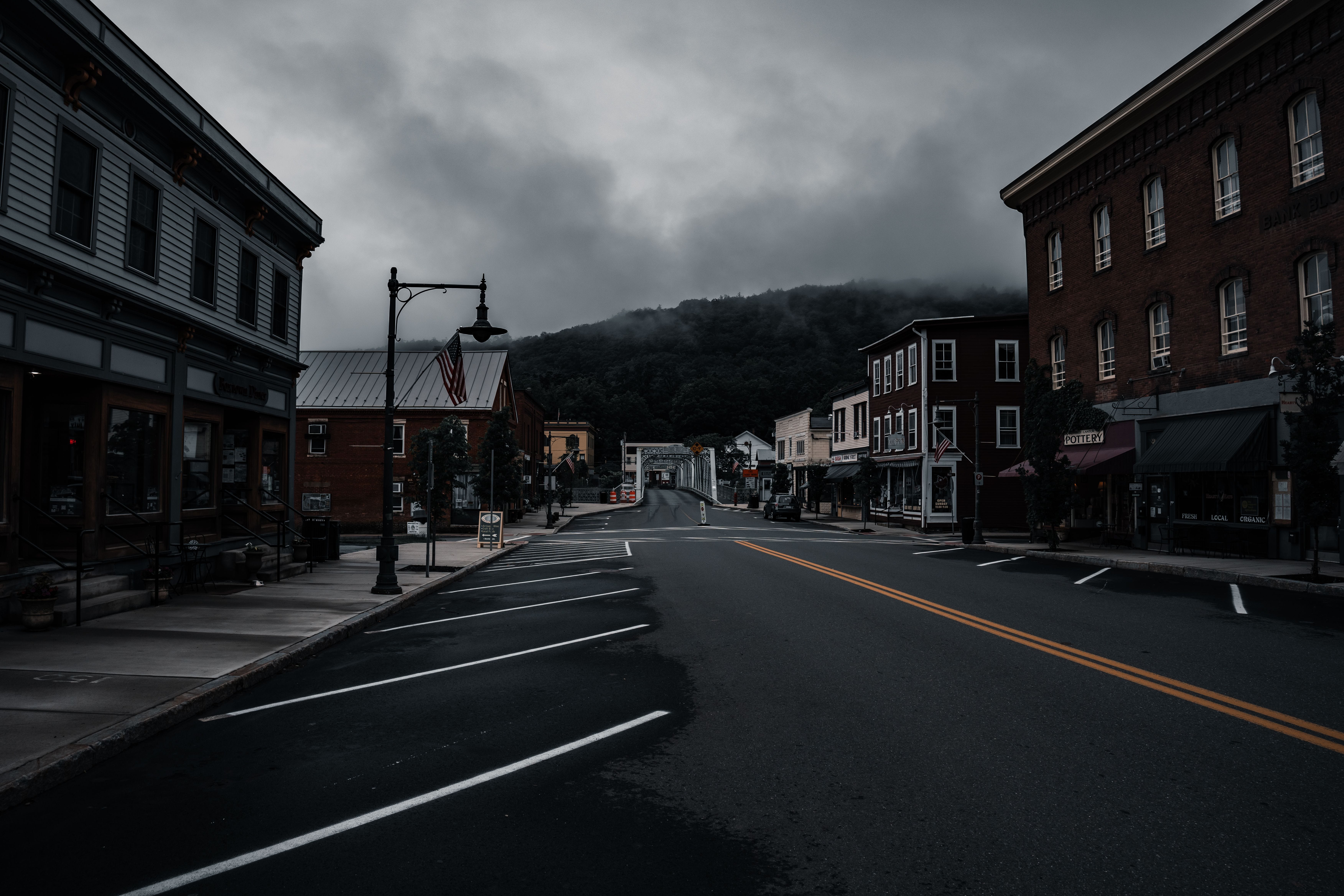
So, imagine it’s a Tuesday in March, a little after seven a.m., and the diner has four people in it besides me. Not just four customers. Four regulars, which is a different category entirely. One of them is arguing with the woman behind the counter about whether the plow crew missed his road on purpose. She’s not taking the bait. She’s also already pouring his coffee without asking, because at this point asking would be an insult.
This diner closes at two. That’s not a failure of the place, it’s just the shape of the day here. If you want something to eat or drink after that, you’re headed to the pub, because the two of them split the day between them without ever discussing it. Somewhere in this town is open from six in the morning until eight at night. But it’s not the same somewhere.
Across the lot, the hardware store hasn’t opened yet, but there’s a truck already backed up to the feed store loading door and a guy in Carhartts leaning against it, waiting, in no apparent hurry. Nobody’s in a hurry here in March. That’s kind of the point.
This is not a postcard moment. Nothing about it is trying to be seen. The snowbanks are the gray, gritted, end-of-winter kind. The flag outside the fire station is a little tattered. But from mid-October to mid-May, this is the day to day picture of the town. It’s not boats and fireworks; its waves from across the street as you dash into the gas station and its figuring out which of your neighbors to talk politics with over a pint and which to stick to conversations about music and dogs and books.
And it’s a pretty good test, I think. Not what a town looks like in September. What it looks like in March.
Here’s what I don’t think is true, though I used to believe it: that some towns are open all year and some towns roll up the sidewalks in October. That’s not how it actually works. Every town up here behaves differently in January than it does in July, and there isn’t a single one that’s fully itself in both seasons at once. What’s actually true is smaller and more interesting than that. Every town has something. Only a few have all the things. And which few keeps shifting, year over year, one storefront at a time.
How to Settle into Small-Town New Hampshire

You moved here for a reason. Maybe it was the lake. Maybe it was the quiet, or the space between houses, or the way you could actually see stars at night. Maybe you were ready for a life where you knew your neighbors’ names and your commute involved mountains and lakes instead of interstate gridlock.
A decade ago, a lot of the Main Streets around here had those hand-lettered signs in the window every October. See you next season. Some of that has quietly shifted, not because anyone ran a campaign about it, but because enough year-round people decided they didn’t want to drive forty minutes for dinner every time they wanted someone else to cook, and enough business owners noticed and stayed open to meet that demand. But almost every town has at least one with closed for the season taped in the window, and some towns have a lot more than one. But that’s okay. Those aren’t the stores locals were ever walking into. They’re selling sweatshirts with the lake’s name across the chest and wall art about lake life to people who are here for eleven days a year, and that’s a real and legitimate part of how this economy holds together. Nobody who lives here in March needs a sweatshirt that says the lake on it. We’ve already got the sweatshirt from the high school up the road, and the mug we may or may not have “accidentally” walked out of the diner with.
So it isn’t really a have-it-or-don’t binary. It’s more of a spectrum where all the towns have something to offer and some have more this or less of that. Some people have chosen the town where there are five real places to eat in January, every night of the week. Some have chosen the one where it’s the diner in the morning, the pub after two, and the market for whatever’s in between, and that’s enough. And some have chosen the town where none of that is in walking distance, where it’s a twenty-minute drive to any of it, but the twenty minutes is a known and reliable cost, not a maybe. All three are legitimate ways to live here. They’re just different bets about what you want close enough to encounter every day.
Here’s some of what I decided that I wanted, which could be different from what you would choose.
A hardware store that still sells things by the individual bolt, and the guy behind the counter can tell you which one you need without you fully explaining the project. Where you can get chicken feed and a toilet plunger and snow shovel or a lawn mower and spring vegetable seeds and string lights.
A library that’s doing more than holding books. The room in the back where the writers’ group meets on Tuesdays, the folding chairs that come out for a concert nobody paid a ticket to see, the sheet hung up for a movie night in a town too small to have its own theater.
A fire department that isn’t volunteer anymore in most of these towns, it’s professional now, but it’s stretched across two or three towns at once, running on a mutual aid system that assumes your town’s rig might be the one that shows up first in the next town over, and vice versa, without anybody making a thing of it.
A local market where they know you by your third visit, not because you’re memorable, but because your kid worked the register there the summer they turned fifteen, same as half the other kids in town did before him, and because you’re in for chips and coffee and dog food on a Wednesday, the kind of errand that will never justify the twenty-minute drive to the real supermarket.
None of this is about charm. Charm is easy to manufacture and easy to fake for a season. This is about infrastructure. Actual, unglamorous, keep-the-place-running infrastructure, built by people who live here in February, not just June.
By five, the pub’s got its own regulars, a different crowd than the diner’s but the same instinct. A group’s tucked into the corner booth playing cribbage, matchsticks standing in for pennies, and nobody’s kept score on paper in years because nobody needs to. A guy’s setting up in the other corner with a guitar and a small amp, not for a crowd, just because the evening needs a soundtrack and he’s willing to be it for the price of a few pints. Two tables over, somebody’s arguing that the new school bus company can’t find a road they haven’t been late to yet, and somebody else is defending them like they’re kin, and neither one is actually trying to win, they’re just enjoying having something to be wrong about together. The kitchen’s sending out Guinness beef stew like it’s the only thing on the menu, which by 7:30 it basically is, and nobody in here is asking for the wine list, because we all know there isn’t one.
None of this is for anyone. Nobody’s even tracking the cribbage game. Nobody’s going to post a review of the Guinness Stew (well, I might, it’s fabulous by way). It’s just Tuesday, being exactly what Tuesday is, in a town with enough of the right things that Tuesday is worth getting out of the house for.
Here’s to knowing which kind of town you want to wake up to in March, and which one you want to walk into on a Tuesday night.
🧭 Jenn
Keys to the Lakes