

This is part of an ongoing series looking at what different kinds of properties and lives actually look like in the Lakes Region — not by price bracket alone, but by what you’re actually choosing when you choose a place to live.
Almost everyone who starts looking in the Lakes Region starts the same way.
They open a search, type “waterfront,” and wait to see what comes back. It’s not an unreasonable instinct. The water is why most people come here in the first place. The lakes are the thing you see in photos, the thing that pulls at you from a distance, the thing you’ve been imagining when you picture what your life could look like if you made the move.
But here’s what I’ve watched happen, again and again: buyers come in with waterfront as the assumption, and somewhere in the middle of the search — after they’ve seen what the price demands, after they’ve driven around and started to understand what this place actually is — the assumption starts to loosen. Not because they’ve given something up. Because they’ve started asking a better question.
Not: can I afford waterfront?
But: what kind of life am I actually trying to build here? And, what’s required for that life to be a reality instead of just an idea in my head?
Those are different questions. And they don’t always lead to the same answer.
Some of the best lives being lived in this region right now are fifteen minutes from the water. Not on it. The people living them have lake access when they want it — a town beach, a friend’s dock, a public boat launch — and the rest of the time they have something waterfront doesn’t always come with: land, history, a town they can walk through, mornings that belong entirely to them.
Three properties illustrate this better than I can explain it.
160 Browns Ridge Road, Ossipee | $475,000 | 3 bedrooms, 2 bathrooms | 2,082 sq ft | Built 1930 | 12.10 acres
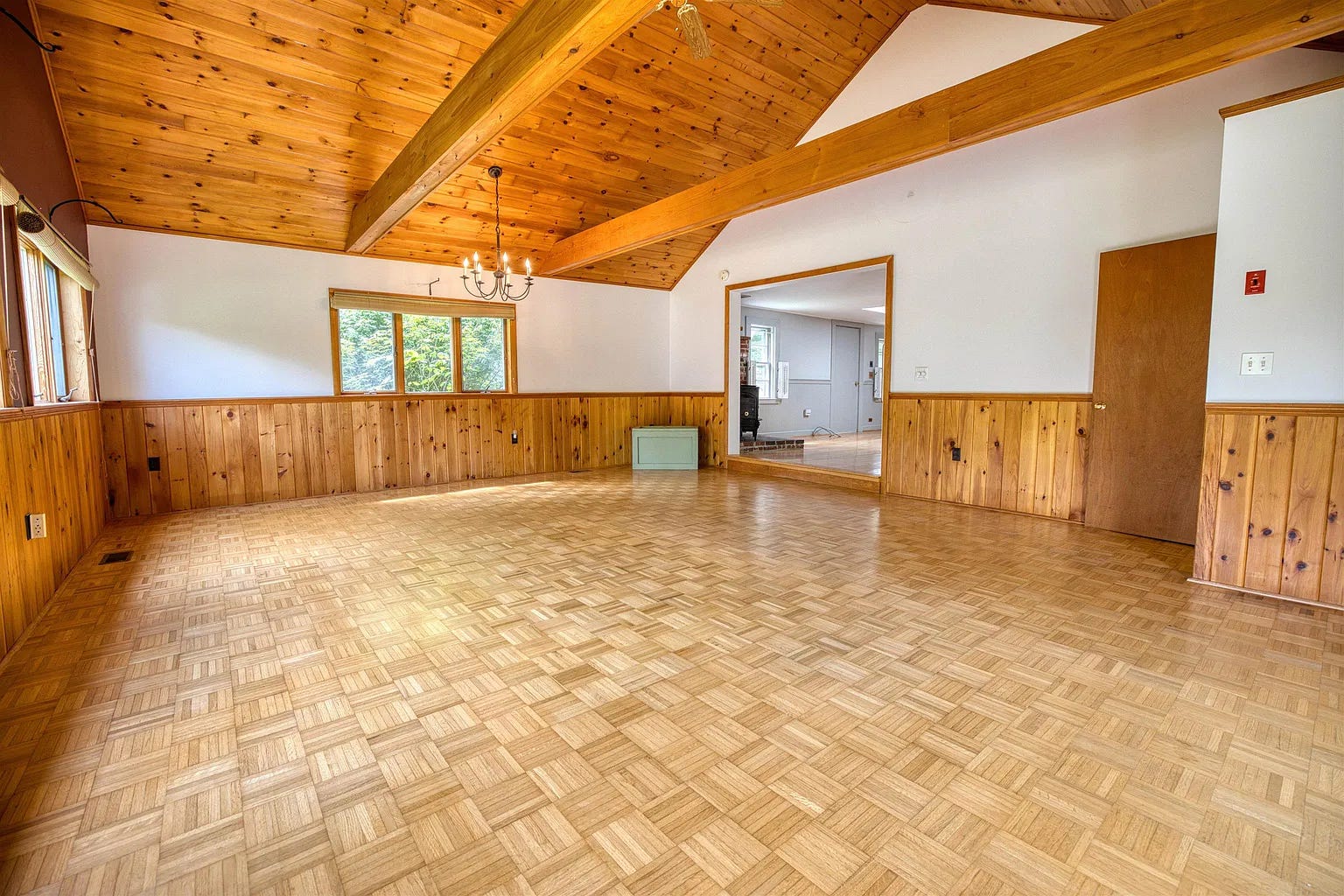
What this property offers: twelve acres of selectively harvested land with a network of paths and trails running through it. A cleared space in the rear of the lot where someone made a deliberate decision to create a gathering spot — not a deck, not a patio, just a place to be outside and feel the property around you. Fields and meadows that open toward glimpses of the Ossipee Mountains, the kind of view that doesn’t announce itself in a listing photo but settles into you over time.
The house is a 1930 ranch, 2,082 square feet, wood stove, cathedral ceiling, hardwood floors, a family room that opens onto a sunny rear deck. Seven rooms including a home office or den. A newer detached shed. Room on the property, according to the listing, to construct an additional structure if you want it.
At $228 per finished square foot, this is 12 acres in the shadow of the Ossipee Range for $475,000.
What this property costs beyond the purchase price is the honest thing to say here. Twelve acres requires attention. Trails don’t maintain themselves through mud season. A 1930 house, however livable and well-proportioned, will have its own list of things to tend to over time. This is not a property that asks nothing of you. It’s a property that gives back in proportion to how much you’re willing to engage with it.
The buyers this fits are people who want the land to be part of the life, not just the backdrop. People who have thought about what it means to walk your own property on a November morning when the light is low and the mountains are just visible through the tree line, and decided that sounds like exactly enough.
314 Sheridan Road, Moultonborough | $650,000 | 5 bedrooms, 3.5 bathrooms | 2,508 sq ft | Built 1850 | 3.16 acres
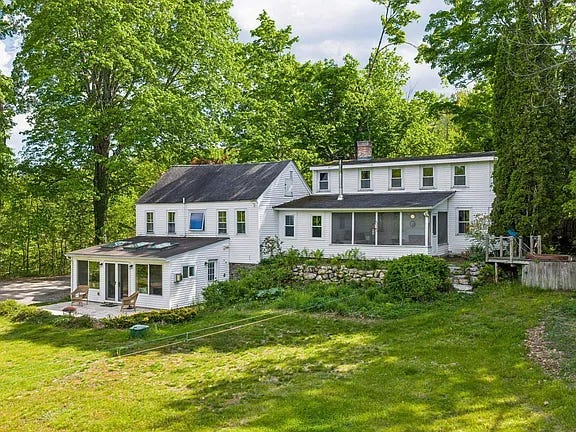
Moultonborough is one of the lowest tax towns in New Hampshire. That matters more than it sounds when you’re running the numbers on what a property actually costs to own year over year.
This 1850 Cape sits on just over three acres in that town, and it has been lived in and added to and cared for in the way that houses accumulate character across a long time. A gentle stream borders the property. A separate barn offers what the listing describes as possibilities for hobbies, storage, animals, or creative workspace — which is a careful way of saying the barn is genuinely useful but it’s not quite clear how, use your imagination. Owned solar panels. A large screened porch that overlooks the backyard. A first-floor primary suite with a clawfoot tub. A wood stove in the den. A fireplace in the living room. A hot tub outside.
Five bedrooms at $259 per square foot in a town that borders Lake Winnipesaukee without charging you for the proximity.
The stream is worth pausing on. It’s not a lake. It’s not waterfront in any sense the search algorithms will surface. But a property with moving water running along its edge has a particular quality — a sound, a draw, a reason to walk the perimeter in the evening that has nothing to do with acreage or square footage. People who’ve owned properties like this tend to mention the stream first when you ask them what they love about the place, which is something to sit with.
Moultonborough also means you are genuinely close to the lake. The public boat launches are a short drive. The marinas are accessible. The lake is part of your life here without being the thing your mortgage is secured against.
116 High Street, Wakefield | $374,900 | 4 bedrooms, 3 bathrooms | 3,180 sq ft | Built 1880 | 0.29 acres
The argument this property makes is different from the other two. It isn’t about land. It isn’t about acreage or trails or a barn waiting for a purpose. It’s about what it means to live in a town that is actually alive.
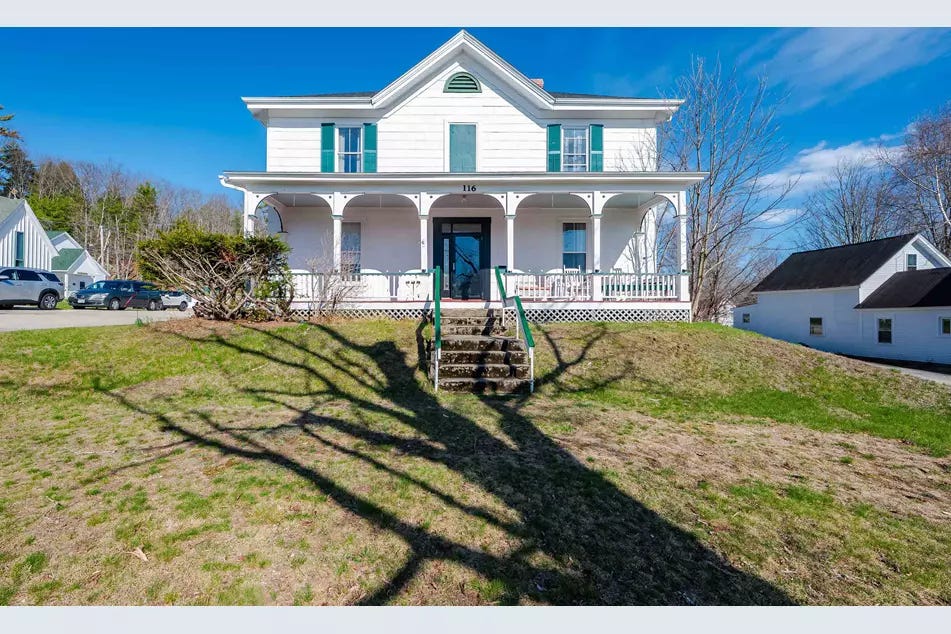
116 High Street is an 1880 Colonial on Wakefield’s main street. Walking distance to local shops, restaurants, and the town center. Walking distance, also, to the town beach — which means lake access is present, just not attached to a deed. Three-plus fireplaces. A grand foyer. A covered porch. 3,180 finished square feet at $117 per square foot, which is the kind of number that makes people double-check the listing.
The recent capital improvements are done: roof in 2020, hot water heater in 2024, furnace in 2025. The heavy lifting on mechanicals has been handled.
What Wakefield offers that doesn’t show up in any field on the MLS sheet is the texture of a town with an actual center. A place where you can walk somewhere. Where the library is a short distance from your front door, not a twenty-minute drive. Where the rhythms of town life — the things happening on a Thursday afternoon in September, the people you recognize at the general store — are available to you not because you sought them out but because you live here.
A lot of buyers coming from suburban or urban environments underestimate how much they were relying on that texture. The ability to leave the house on foot and arrive somewhere. The sense of a place having a middle, a gravity, a reason people gather. Waterfront can give you beauty and water access. It can’t always give you that.
At $374,900, this is the least expensive property in this installment by a significant margin. R1 zoning also allows for a range of uses with a conditional use permit, which is worth a conversation with the town if you’re someone who works from home or is thinking about what a property like this could support beyond a primary residence.
What the series has been about
We started at the entry point of what water access actually costs in this region. Moved up through what $750,000 and then multi-million dollar waterfront looks like and what you’re actually buying at each level.
This installment steps back from the water entirely — not as a consolation, but as a correction to an assumption.
The Lakes Region is often defined by its water and the lifestyle they give us. That’s true. But the towns, the land, the history, the mountain views, the streams running through back meadows — those exist independently of the waterfront market. And for buyers who stop typing “waterfront” long enough to ask what kind of life they’re actually trying to build, what comes back can be surprising.
A 1930 ranch on twelve acres facing the Ossipee Mountains. An 1850 Cape with a barn and a stream in a low-tax town that borders Winnipesaukee. An 1880 Colonial on a walkable main street with town beach access included in the zip code.
None of them are the lakes. All of them are the region.
Here’s to knowing what you’re actually looking for.
🧭 Jenn
Keys to the Lakes
