

People ask me about old houses up here like there’s one kind of old.
There isn’t. There’s colonial. There’s homestead. There’s the thing your great-grandparents built that we often call a camp regardless of size, and the ranch your grandparents thought was modern, and the house that’s “old” only because it’s been here since you were in elementary school. Five eras of housing, all sitting on the same back roads, all asking completely different things of whoever owns them, and all getting filed under the same word: old.
So before anyone tells you what owning an old house is like, it’s worth asking which old house they actually mean.
Colonial: through the 1850s
You’ve driven past one. Maybe on a back road outside Wakefield or Tuftonboro, maybe somewhere up near Effingham. An old farmhouse pretty close to what is now the road, paint gone soft with age, a chimney that’s clearly been rebuilt at least once. And some part of you slowed the car down, just a little, and thought: what would it be like to live in that.
I can tell you. I live in one. This one.
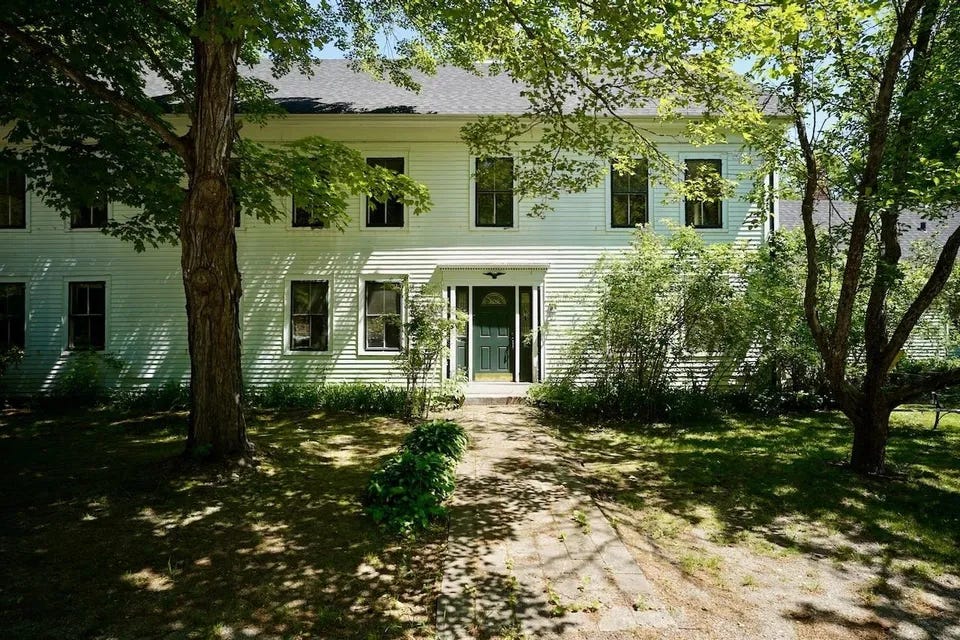
Mine was built in 1769. Seven years before the Declaration of Independence. I think about that more than is probably normal, mostly because the house won’t let me forget it. Nothing in here runs in a straight line. The floors slope toward the chimney like they’re being pulled there. The doorways are all crooked enough that you feel a little bit like you’re on a ship at sea. Every tradesperson who’s stepped inside has gone quiet for a second before saying some version of “well, that’s old houses for you.” Not an indictment. Just a fact, delivered the way you’d mention the weather.
So let’s actually talk about what this era asks of you. Not the romantic version. The real one.
It asks for total participation. There’s no insulation standard from this era, no level floor, no system built with today’s expectations in mind. The floors aren’t level because the foundation has settled for 250 years, and you cannot logic your way into a level floor without changing the character of the thing you bought it for in the first place. Your heating bill in January will make you wince, every year, on a predictable schedule. Something will need attention nearly every season; a door that swells in July and won’t latch right until October, a sill that’s softer than you’d like, a chimney that needs a look before you build a fire in it again. None of this is a secret kept from buyers. It’s just a cost that doesn’t show up the way a kitchen renovation shows up. It’s slower. Quieter. It adds up in a hundred small invoices instead of one big one, and that’s actually harder to plan for, not easier.
What it offers back, if you want it, is something no other era on this list can give you. Some mornings, walking from the bedroom to the kitchen, I think about the fact that someone did this exact walk in 1820. In 1875. In 1940. Someone’s skirts brushed this same uneven floor while she got her kids up and moving. Someone stood at this same window in February, looking at the same shape of these same hills, wondering the same thing I wonder: how much longer is winter going to last this year.
That’s not something a new build gives you. You can build a beautiful house tomorrow with perfect insulation and a level floor in every room, and it will be a wonderful house, and it will not have that. The crookedness and the cost are the same thing, really. You’re paying, in dollars and patience, for the privilege of being one stop on a line that’s two and a half centuries long. I’m not the point of this house. I’m a chapter. A fairly short one, statistically speaking, in a book that started with someone driving a wagon up what was probably still a dirt path.
Homesteads and Cottages: 1850s to 1900
This is the era of the working farm scaled down, and the first lake camps built by people who wanted a season here, not a year. You’ll recognize it by the additions; a kitchen ell tacked onto the back, a woodshed connected by a breezeway, the unmistakable sense that the house grew the way a family grew, one decision at a time instead of one blueprint.
What it asks of you is patience with inconsistency. These houses were rarely built by one builder with one plan. They were built, then added to, then added to again, and you can usually feel the seams if you know where to look; a doorway that doesn’t quite line up with the hallway it opens into, a floor that changes height by an inch where one century’s addition meets the last one’s. The wiring in one room sometimes makes more sense than the wiring in the next, and the foundation under the original structure has had decades longer to settle than the foundation under the addition.
What it offers back is character that wasn’t designed, which is a different thing from character that was. There’s a kind of charm in a house that accumulated itself instead of being planned, room by room, by people solving problems as they came up rather than from a single vision. It feels lived-in because it was; by people building exactly what the next winter or the next baby required, and nothing more than that.
Pre-War to Post-War: 1900 to 1950
This is the era where indoor plumbing stopped being a luxury and electricity stopped being a novelty, and you can usually feel the difference the moment you walk in. The ceilings get a little taller. The windows get a little more generous. The whole house starts to look like one a person living today might actually recognize as a house, rather than a museum or artifact someone happens to live inside.
What it asks of you is less than the two eras before it, but it isn’t nothing. Wiring from this period was a genuine improvement over what came before it, and it is also, by current standards, a genuine liability; knob-and-tube doesn’t meet most insurance requirements anymore, and replacing it is rarely a small job. Plaster walls crack in ways drywall doesn’t, in long hairline fractures that show up every few years like a sort of seasonal handwriting. The systems are closer to modern, which sometimes means people underestimate how much “closer” still isn’t “current.”
What it offers back is a real foothold between two worlds; old enough to have presence, recent enough to renovate without a specialist on speed dial. For a lot of buyers, this is the sweet spot. Character without the full commitment colonial asks for.
Mid-Century: 1950s to 1978
This is the ranch your grandparents thought was the height of modern, the camp that got winterized somewhere along the way, the four-square that’s aged into “vintage” without anyone quite deciding to call it that. It’s not old in the way that gets written about. It’s old in the way that quietly makes up a huge percentage of what’s actually for sale in this region, sitting modestly between the atmospheric colonials and the photogenic brand-new builds, doing most of the actual housing.
What it asks of you is mostly about systems, not structure. The bones are typically sound, code-compliant for their time, built with materials that have held up reasonably well across sixty-some years of Lakes Region winters. What dates them is the boiler, the panel, the layout that made sense in 1962 and feels closed-off now; a kitchen that turns its back on the rest of the house, a basement that was never meant to be anything but storage. The asks here are real, but they’re closer to “modernize” and “make it yours” than “preserve.”
What it offers back is flexibility. These houses tend to be more forgiving of change than anything older; you can open a wall, add a bathroom, finish a basement, without the same conversation about what you’d be erasing in the process. It’s history light enough to renovate without grief.
Contemporary: 1978 onward
This is the era built to current code, with insulation standards, electrical systems, and structural assumptions that match how we actually live now. Walk into one of these and the difference registers in your body before your brain catalogs it: ceilings that don’t require a six-foot frame to clear them, outlets wherever you’d actually want one, a furnace that doesn’t require a personal relationship with an oil delivery schedule to keep the house above sixty in January.
It asks the least of an owner; not nothing, every house asks something, but the asks here are closer to maintenance than stewardship. A roof that needs replacing on a predictable thirty-year clock instead of a mysterious one. A water heater that fails the way appliances fail, not the way two-hundred-year-old systems negotiate. You’re not learning the personality of a building that’s had two and a half centuries to develop opinions. You’re mostly just changing filters and keeping receipts.
Plenty of wonderful houses up here fall in this category, and there’s no extra credit for choosing an older one instead. Open floor plans that actually open, instead of a colonial’s stubborn insistence on small, separate rooms built for separate fires. An attached garage, which on a February morning is worth more than most people admit out loud. A kitchen with enough counter space that two people can actually cook in it at once without one of them backing into the woodstove.
This is also, often, where the actual logistics of a family’s life happen, regardless of which era someone’s heart is set on; the school bus stop, the driveway that gets plowed without an act of faith, the basement that was built to be finished instead of merely tolerated. It doesn’t ask you to earn it the way a colonial does. It just works, mostly, the way it was built to. There’s something to be said for that, even if it doesn’t come with a story about the woman who walked these same floors in 1875.
So which one are you actually buying?
The mistake I see most often isn’t choosing the wrong era. It’s not knowing what each era asks of you, and discovering the gap between what you imagined and what you signed up for sometime around the first January heating bill.
A colonial and a mid-century ranch can sit a quarter mile apart on the same road and ask entirely different things of the people who live in them. A few honest questions, regardless of which one you’re looking at: Do you want a project, or do you want a house that’s finished? Be honest with yourself here, because an old house, in almost any of these eras, is never quite finished. It’s maintained, indefinitely, by someone who’s made peace with that being the deal. Do you like knowing how things work, or would you rather not think about it? In an old house , you’ll learn more about your own foundation, your own roofline, your own well than you ever planned to, and some people find that satisfying while others find it exhausting. Both reactions are normal. You should know which one is yours before you sign anything.
And one more, separate from any era: not everything old is worth this. There’s a real difference between a building that’s carrying something; the way it was built, what it meant to the people who built it, and a building that’s simply old. Drafty for no good reason. Structurally tired past the point where saving it serves anyone, including the building itself. A region that’s only old feels like a museum. A region that’s only new has no beathing heart to call upon. The towns up here that feel most alive are the ones holding both, an honest colonial and a good new build, on the same road, without apologizing for either one.
Neither era is the right answer on its own. They’re just different questions, and it’s worth knowing which one you’re actually being asked before you say yes.
If you’re someone who slows the car down on these roads, who wonders what it would be like, I’d rather tell you the truth than the fantasy about whichever era caught your eye. Your body will tell you before your spreadsheet does.
If you’re thinking through what kind of old house actually fits the life you want here, that’s a conversation I have often, and happily. Even if you’re just trying to figure out which era you fell in love with from the road.
🧭 Jenn
Keys to the Lakes
