

I went looking for a woman in the Lakes Region who wrote down her day between 1770 and 1850. A diary, a letter that mentions the churning, an account book with her name on the credit side. I’m still looking.
I have a theory about why she’s so hard to find. She was too busy doing the work to write about the work. And I suspected, until the research was done, that she was often a long way from the next kitchen, with no one around to compare notes with. I had a vision of a stoic, hardworking, lonely woman, who relied on her family for company and waited for visitors from Portsmouth to share news. I would love to tell you the records prove it. They do not, and boy was I wrong about the company piece.
Here is what the local sources give me. Wolfeborough’s town history, published in 1901, describes the table: rye-and-Injun bread, bannocks baked on edge before the fire, boiled corn, bean porridge, hasty pudding. It describes flax, spinning, and a loom in almost every farmhouse. In the pages I read on women’s work, the only woman it names is Mrs. Nancy Edgerly, in a photo caption, at the age of 105. That is the entire record of the women. A caption. Keep that in mind as you read on about what they contributed.
For a full picture of the work, I had to leave the region. Martha Ballard lived in Hallowell, Maine, on the Kennebec River, and from 1785 until she died in 1812 she wrote in a diary almost every day. This is not a Lakes Region story and I won’t pretend it is. Her husband ran a sawmill and she was the town midwife. But it is the same kind of country in the same decades, and she wrote down what the Wolfeborough book can only describe.
Start with the hearth. In March 1809 she baked brown bread, mince pies, apple pies, and pumpkin pies, with three granddaughters sleeping over. In June 1808, on a morning with frost, she baked pumpkin pies. Late in June 1811 she wrote that she had “bakt & Brewd,” and that she felt much fatigued. I feel fatigued just thinking about all that baking.
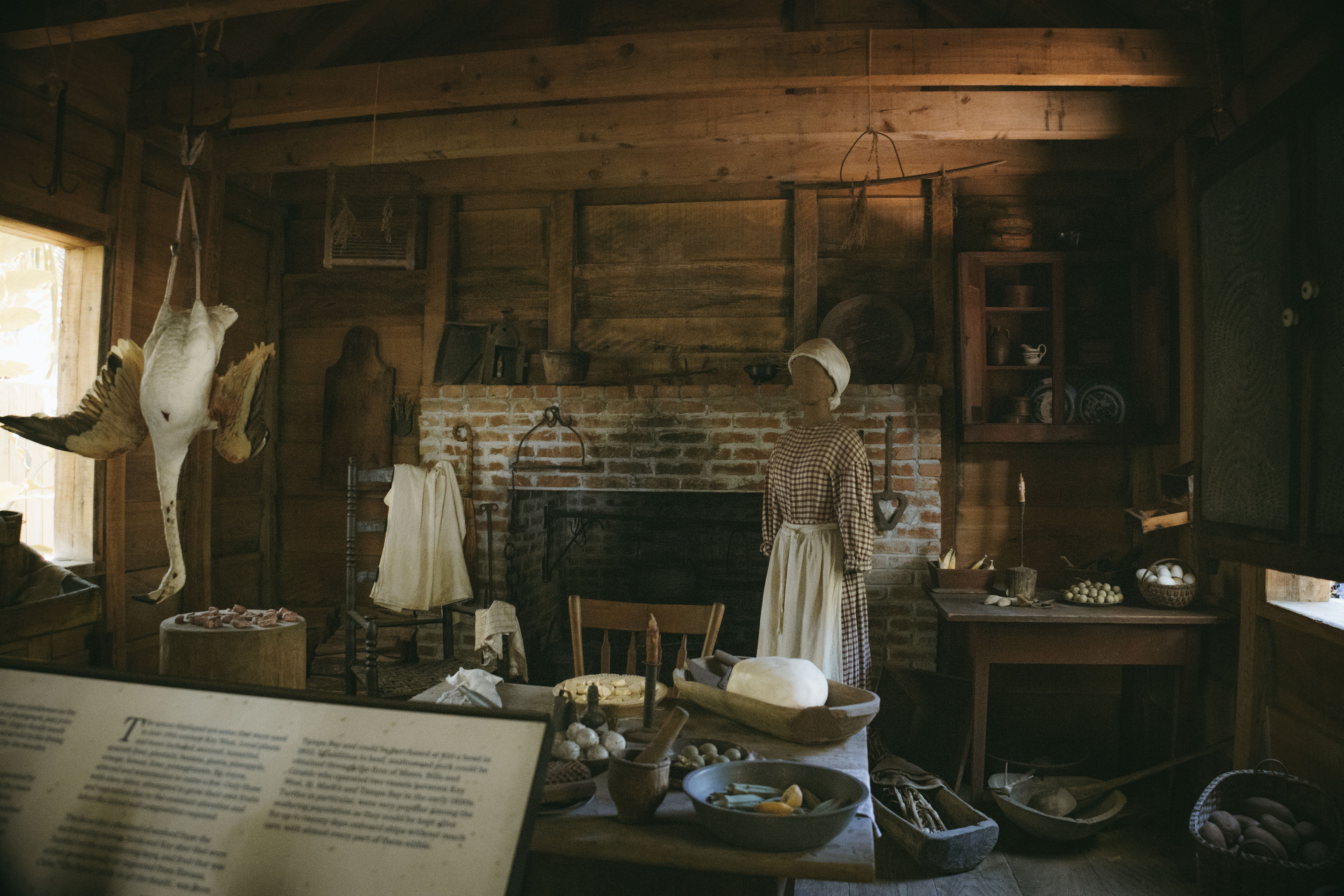
Then the dairy, which ran on the calendar. Old Sturbridge Village researchers say New England women made butter in the cool of spring and fall, and turned to cheese when summer heat came. In mid-June 1806, Ballard counted: twenty-two pounds of butter and twelve cheeses in the eight weeks since the calf was killed. She was seventy-one.
Then the garden and the yard. In May 1800 she planted potatoes, squash, and musk melons, and the next day baked, churned, made a cheese, and ironed her clothes. In June 1808 she hoed the corn and cucumbers and weeded part of her onions. In May 1811 she scraped moss off five apple trees. One day she cut grass with a knife between the house and the pigpen. (I’m sure some of my neighbors reading this are raising their eyebrows and noting that my grass wasn’t cut most of this summer and I don’t have to rely on a knife). And Ballard was not unusual in doing so much outside labor. Old Sturbridge Village’s research finds many New England women raked, turned, and loaded hay when haying season pressed.
Then the washing and the mending. A large washing in April 1788, with Polly Savage helping, and Ballard wrote “I paid her in flax.” That December: “we were boiling Soap.” She ironed, mended trousers, mended a shirt for her husband. Candles didn’t come from a store either, and one Vermont museum puts it plainly: every candle in those candlelit evenings had to be made.
Cloth was in there too, and it was real work. On February 22, 1787 she wrote “I knitt all Day,” and 21 and a quarter yards of cloth arrived that day, woven for her by Sally Bolton. In early April, twenty pounds of flax combed on two days running. But it was one job among all the others, not the whole job.
And the rest was care, which never made a column. Her husband was unwell in June 1806. On June 24, 1804, she wrote that she was in pain but “have had my work to do.” Betsy Church came to help, and they baked pies and bread. Not to mention all the babes she helped birth, the mothers she healed, the tinctures she probably made.
Notice what runs through all of it. Trade. A neighbor took six sheep for a year in 1808 and paid in six pounds of wool. A daughter sent a pound of butter. Another sent ten pounds of rice. The household ran on small exchanges, mostly between women, and mostly never counted in a ledger.
In 1816 came the summer that wasn’t. The Wolfeborough book gives it a few lines, set down long after: snow on the sixth of June, frost in every month, no sound corn raised. Corn, where you could find it, ran two dollars a bushel, and a day’s work bought a peck of the frost-bitten kind. Some farmers with a store put by would sell only to the needy. In Tamworth, the town history says a cold northwest wind from the second of June left half an inch of ice and killed the corn and beans. Go back to that table, the bread and the bannocks and the porridge. Much of it leaned on corn. A kitchen that ran on corn did not get a different set of ingredients. The record has the price of the corn. It does not have the cook who had to get real creative that particular year, and I bet lots of other times, too.
Now look at that company. One October day in 1788, “mrs Williams here all Day,” with two more visitors. Her house was almost never empty. Parker’s Wolfeborough has the same texture: spinning bees, carding parties with tea. That puts a dent in my neighbor theory. These women were short on time, not on company. Just like today.
The busy part holds up better. Ballard wrote by candlelight after her family had gone to bed, and by one account she kept the diary mainly to track her midwifery. The record exists because part of the work could be billed. The rest got a line, or nothing.
I don’t have a count of neighbors for any one Lakes Region farm in 1800, and I won’t invent one. What survives near here is thin. A Sandwich woman named Sally Hoit left thirty-nine letters between 1803 and 1837, and a diary for two years, 1823 and 1830. I haven’t read the diary yet. Most of the early account books I found were kept by men, for their trades. The town histories came a century or more after the fact.
At the Remick farm in Tamworth, they still teach people to cook over a hearth, piling coals in front of the fire to make a burner. A nine-year-old visitor from Wolfeboro reportedly told one of the staff, “Imagine doing this every day your entire life.” She was right. No wonder there’s so little record of it all, the time was spent in the doing, rather than the recording.
If this made you think of someone who loves this region, send it their way.
Here’s to the work nobody wrote down.
🧭Jenn
Keys to the Lakes
