

Late October feels like the right time for this observation. The leaves are still clinging and colorful, but more and more of them fall every day, the light comes in low and sideways, and old stones show their carving the way they never do at noon in July. This weekend, I was hosting an open house on Ames Road in Moultonborough when I came across a small family cemetery nearby. It had a stone wall around it, a few leaning markers, and more pine needles than lawn. One headstone had a flower carved into its face, worn so soft by weather that the petals had gone to suggestion. A daughter, twenty, in the 1870s. I took a photo, and then I stood there longer than the photo needed. I was thinking about what it means to rest in ground your family owned for a hundred years before you and almost a hundred years after if the latest date I could identify, 1943, is any indication.
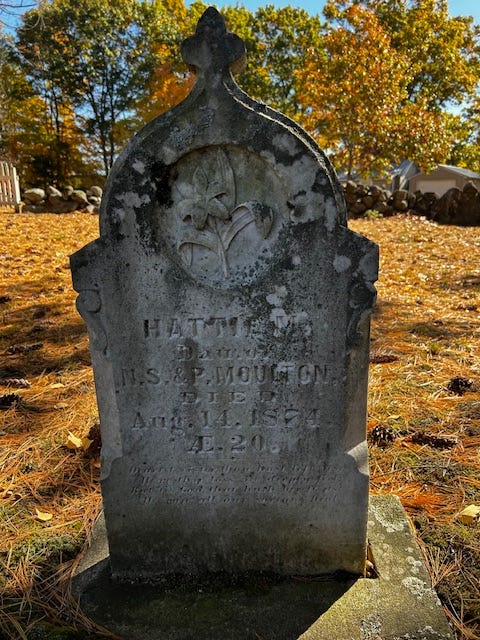
It is spooky season, which means this is the time of year when people go looking for the haunted version of a place like this. I understand the pull. Low light, old names, a gate that might creak. But I have spent enough time in these places to tell you that the feeling I get in them is not dread. It is closer to the feeling of walking into a kitchen where someone has just stepped out.
I have one of my own. The people who built my house are buried across the street, in a small plot that is no longer part of my land. One of them, according to local lore, is Mehitable. I go over sometimes and talk through renovation plans with her. Local tradition says she never entirely left the property, and if that is true, she has been remarkably patient with me. We get along just fine.
I do not think of that as eerie. I think of it as manners. If you are going to rip out a wall in someone’s house, the least you can do is mention it.
A plot like hers is not an oddity of the Lakes Region. It is how the region worked. Families on larger farms often set aside a small piece of their own land for burials. Sometimes the nearest town cemetery was miles away. Sometimes it was simply the custom, or a desire to keep generations together on the land they had worked. A town history from southern New Hampshire, written in 1969, noted it as plain custom: a farm family set aside a small piece of ground for this purpose. Durham alone counts more than seventy-five of these old family burial grounds, some going back to the 1600s. Closer to home, a recent Brookfield survey documented seventy-two historic burial grounds in a town of barely a thousand people.
What nobody planned for, of course, was the eventual sale of the property that housed generations of family members. Farms were eventually divided, parcel by parcel, and the burial ground did not move. Land that was once all one family’s became several owners’ land, and a small walled square ended up across a road, or at the back of a field, or in somebody’s side yard, with no one around who remembered how it got there. Some of the stones are down. Some graves never had a stone at all, only a fieldstone or a wooden marker that rotted a century ago.
The law took notice, and it is worth knowing if you ever buy an older property here. New Hampshire law protects burial grounds even when they are not identified in a deed. Building and excavation near known burial sites are restricted; where a town has no ordinance of its own, state law generally prohibits new construction within twenty-five feet. And if a burial ground has no public access, someone wishing to maintain or preserve it can apply to town officials for temporary entry across private land, with the landowner’s written permission. None of it strikes me as a burden so much as a boundary of the old kind, the sort drawn by respect before it was drawn by a surveyor.
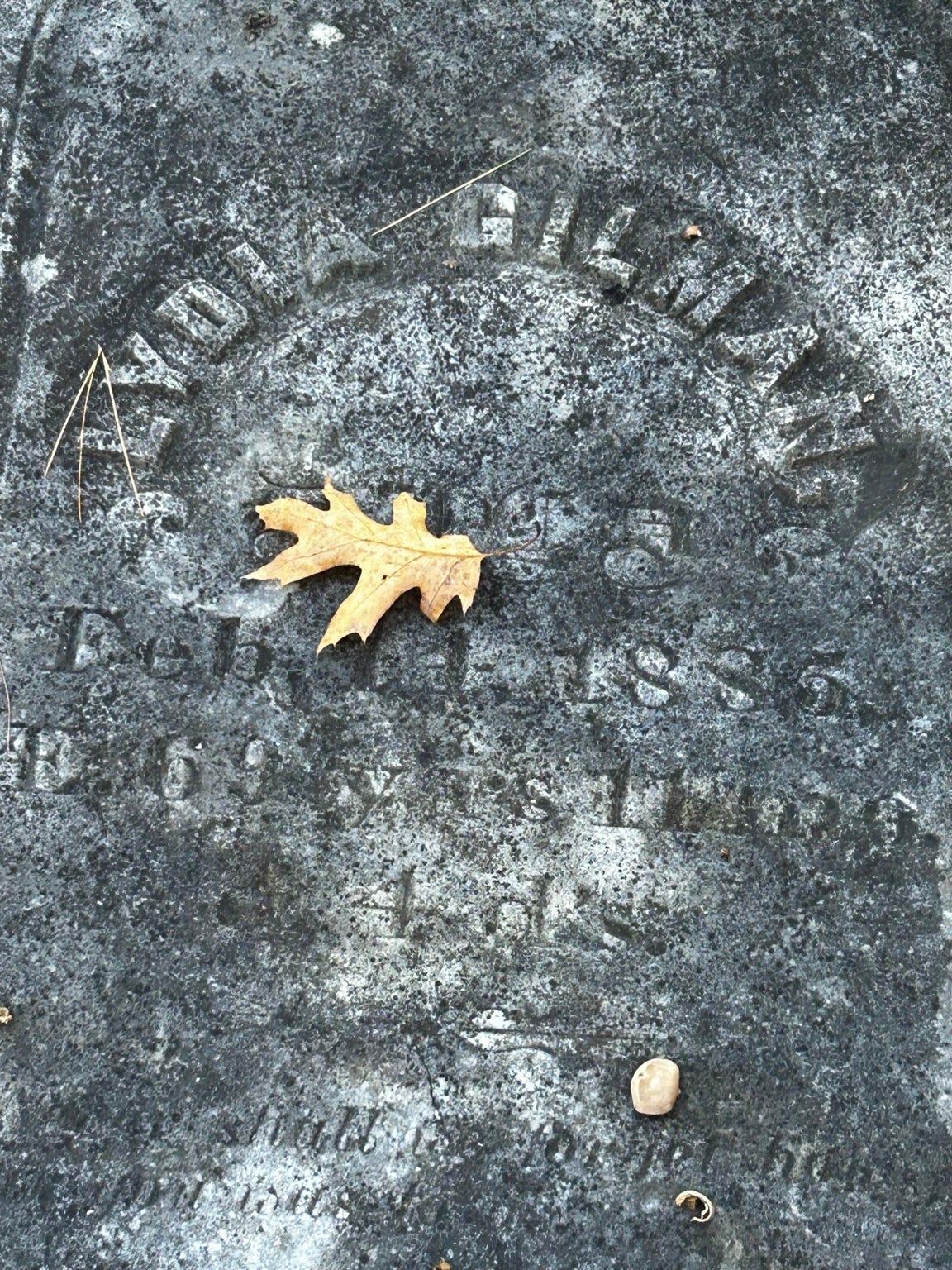
So the burial ground stays, even as the surrounding land changes hands. It may belong to a different parcel now, or sit just beyond a new boundary line, but its history remains part of the place. It is a quiet sort of inheritance, whether anyone mentions it at the closing table or not. And the stones themselves tell stories. Some are little more than rough fieldstones, while others are carved with weeping willows, urns, flowers, and other symbols of mourning. Even generations later, when the names have almost disappeared, the care that went into remembering someone is still visible.
Nothing about that is spooky. It is a record of people who expected to stay, who built a house to last and put their own in the ground nearby, and trusted that whoever came next would have the sense to leave the wall standing. These small cemeteries belong to all of us, as part of where we live and what came before. Mehitable would say the same, I think. Or she would, if she were the kind to say much.
Here’s to honoring the old stones, and to whoever’s keeping them.
🍂 Jenn
Keys to the Lakes
