

This series started at the entry level of water access, then moved up through the $750K tier and into the multi-million-dollar waterfront, then turned inland to see what your money buys away from the water. Each installment isolated one variable: proximity, privacy, what kind of unique you were paying for.
This one seeks to deepen the series, because the farmhouse isn’t a price tier. The four houses featured below run from $425,000 to $1.25 million, and they’re all the same category of purchase. The variable isn’t just price. It’s how much of the conversation with the house has already happened, and how much of it is going to be yours.
I say conversation deliberately. As regular readers know, I live in a house that turned 257 this year, and it talks. It tells you when the wind is blowing harder than it was yesterday. It tells you which windows want attention before which winter. You don’t own a house like this so much as hold up your end of an exchange that started long before you and will keep going after. What you’re deciding, when you buy one, is where in that exchange you want to enter.
515 Hollow Hill Road, Tamworth | $425,000 | 4 bed, 2 bath | 2,800 sq ft | Built 1792 | 3.42 acres
The Deacon Chesley house, and the least expensive way into this piece at $152 per finished square foot. The hand-hewn timber frame is exposed through the main living space, there’s an attached art studio with its own entrance, and two of the bedrooms have their own working fireplaces that have been throwing heat since Washington’s first term.
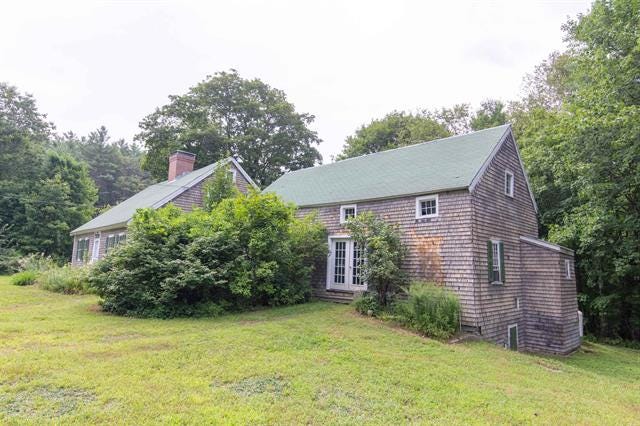
Here’s the detail worth noticing: the listing says the first floor was completely remodeled between 2016 and 2019. Read that again for what it doesn’t say. The renovation stopped at the top of the winding staircase. When someone tells you precisely which part of a house was redone, they’re also telling you which part wasn’t.
The other quiet fact is the road. Hollow Hill goes from pavement to gravel before you reach the house. Public and town-maintained, yes, but gravel in the Lakes Region means you and mud season are going to know each other on a first-name basis, every April, forever.
What this house demands: finishing someone else’s paragraph. The first floor reflects the last owners’ taste and budget. The second floor is waiting to reflect yours, and 1792 post and beam does not take drywall-and-done answers.
240 High Street, Madison | $489,000 | 3 bed, 1 bath | 1,712 sq ft | Circa 1900 | 15 acres
The second of three farm homes on the east side of High Street, and the one where a current owner grew up when it was still a dairy farm. The milk was processed in the lower level of the house. The 33 by 33 barn still stands, metal-roofed and recently shored up. Fifteen acres of open field roll east toward the hills.
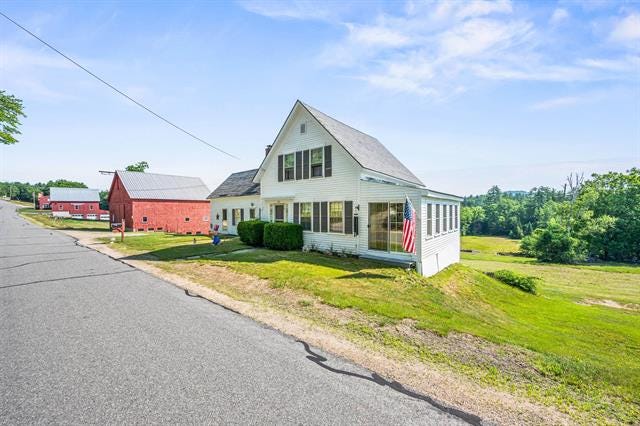
At $286 per square foot, it’s the most expensive house in this piece by that measure, which sounds backwards until you realize you’re not buying square footage. You’re buying the fields.
And here is the line buried in the middle of the listing that matters most: the land is in current use. That’s a property tax program, and it’s a gift while you leave the fields as fields. The moment you carve off a lot or build on that acreage, you trigger a land use change tax. The land is inexpensive to hold and expensive to change. Know that going in, because it should shape what you think this property is for.
The sellers are also honest in a way I appreciate: they’ve lived here six months a year lately, the well is a dug well, the septic is older and will eventually need replacing, and the house needs some work to be a year-round home again. It’s being sold furnished, which tells you something about the kind of goodbye this is.
What this house demands: patience with systems that were sufficient for the life being lived, and a plan for the life you intend to live. A dug well and a 1900 farmhouse kept as a summer place will meet a year-round family with a list of updates and improvements that you should take into consideration before you fall in love and sign.
163 Maple Ridge Road, Sandwich | $729,000 | 4 bed, 3.5 bath | 3,539 sq ft | Circa 1794 | 14.8 acres
Believed to be among the oldest surviving homesteads in North Sandwich, sitting on a knoll with the Ossipee Range in view and a year-round pond across the road. Wide pine floors, gunstock corners, hand-hewn beams, southern light, stone walls running the property lines, and a barn roughly 75 feet long. The town lists suitable uses that include maple sugar, which in Sandwich is not a decorative suggestion.
Now notice what the listing doesn’t mention, anywhere: a heating system. A septic update. A well. Electrical work. For a property this thoroughly described, the silence on mechanicals is the loudest thing on the page. And when you look into the disclosures, it’s honest: the systems date to 1974. The word the listing leans on is restore, and it means it. This is the house where the conversation hasn’t started yet. You’d be starting it and it might be an intense one.
What this house demands: a restoration budget you build before you offer, not after you close, and the temperament to spend years at it. A 75-foot barn is a magnificent thing and also its own line item, indefinitely. This is the purchase for the buyer who has read about what a colonial actually asks of you and answered, out loud, yes.

1080 N. Barnstead Road, Barnstead | $1,250,000 | 5 bed, 4 bath | 4,510 sq ft | Built 1880 | 12.21 acres
The other end of the spectrum. An 1880 farmhouse on a former potato farm, bordering 8,000 acres of conservation land, restored top to bottom over five years. The sellers hired a plasterwork specialist whose résumé includes Strawbery Banke, brought in a structural engineer, redid the electrical and plumbing, planted an orchard, and got town approval for a 1,288 square foot ADU above the four-car garage. The listing says you’re not buying a project home that becomes a part-time job, and for once that claim has receipts.
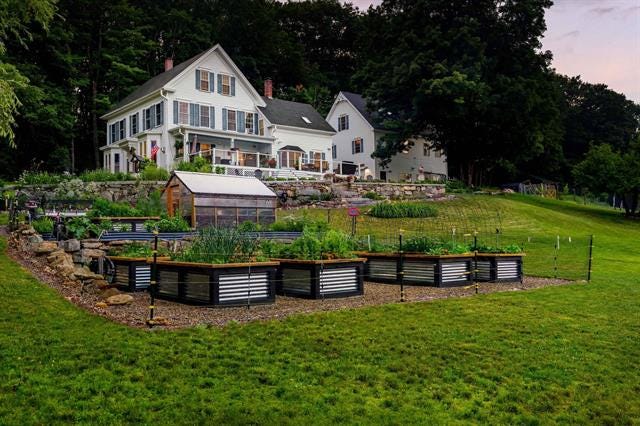
The detail I’d flag sits in the fine print: the road frontage is listed as TBD, and the road itself is a dead-end dirt road. That’s the price of never seeing another house in any direction. You’re the last address the plow reaches, or you’re plowing it yourself, and in March that distinction is not academic.
What this house demands: comfort with the idea that you’re paying $277 a square foot for someone else’s finished vision, and you’ll live inside their choices, good as they are. It also demands a farmer’s hours, or a farmer’s hire. Fields, orchards, and gardens do not maintain themselves out of gratitude for having been restored.
What this series has been about
We’ve moved from entry-level water access up through the price tiers, out to the multi-million-dollar waterfront, then inland, and now sideways, into a category that runs the whole price range at once. The farmhouse installment sits here on purpose: it’s the clearest proof that what you’re buying is never just the number. Four houses, one category, an $825,000 spread, and the real difference between them isn’t cost. It’s whether you want to finish a conversation, maintain one, start one, or purchase one already resolved.
If one of these houses has been sitting in your head since you scrolled past it, I’m happy to talk through what it would actually ask of you. Even if you’re just thinking out loud.
Here’s to knowing what you’re actually looking for.
🧭 Jenn
Keys to the Lakes
