

It’s late October. The docks are out of the water and the boats are wrapped up in the yards or storage bays. I even turned on the furnace and moved the chickens to their winter residence in the hopes of winter eggs. And, in conversations with clients and other agents, there’s a ton of buzz right now that the summer didn’t leave time or room for. Clients are mostly asking, Should I stay? Should I go? Did I miss my chance?
I’ll say this plainly before anything else. Times are hard for a lot of people right now. Rates are up, the future is harder to read than it was a year ago, and the uncertainty is real. If you’ve been going back and forth on a house, you’re in good company, and it doesn’t mean you’re slow or indecisive. It means you’re paying attention.
So I want to start with what I can actually see, and then be honest about what I can’t.
I pulled single-family closings in Belknap and Carroll counties, between $500,000 and $900,000, from September 1 through October 22, and set them beside the same stretch last year. Both years had about 120 closings in that six week period. The median closing price was $630,000 this fall and $632,000 last fall. The median home spent 22 days on the market, both years. Fifty-five percent sold within 30 days this year, against 56 percent a year ago. Close enough that I’d call it the same year, on paper.
About three in ten sales took two months or more. That’s part of the picture, and I’d rather not leave it out. But the difference from last year is small, and I wouldn’t build anything on it. It could be noise.
Now the part I can’t see, but that I definitely feel. This file counts closed sales, and most of those deals were made in August and September. Rates have climbed through October, to about 7.4 percent, roughly a point above where they were a year ago. Whether that shows up in the numbers isn’t visible yet. I’d rather tell you that than hand you a tidy conclusion. Anyone who says they know what November looks like from a file of September closings is guessing.
And even a clean number only goes so far. A median describes a pile of houses. It says nothing about your house, your equity, your timeline, or what comes after the closing.
Here’s what I’m seeing, and this is my read, not the data’s. Sellers are hesitating. Buyers are hesitating. Some sellers are pricing above what the agents advising them recommend, and plenty of buyers are hoping for a turnkey house at a bargain, which is a short list in any year. None of it surprises me. It’s what hesitation looks like from where I sit.
I don’t think the hesitation is about whether a house will sell. The numbers say houses are selling. I think it’s about the next one, about where you go after you sell, and what it might cost you. Here’s the arithmetic, and it’s mine, so check it. Hold a monthly payment steady, and today’s rate buys about 11 percent less home than it did a year ago. I’m not describing anyone’s loan. It’s a general point, and it’s why the question has changed. It used to be, will mine sell? Now it’s, if it does sell, can I find something that is a meaningful upgrade in either cost-savings or lifestyle? That’s a harder question to answer these days.
That’s why I won’t tell you whether to buy or sell. I can’t, and I’d be wary of anyone who says they can from a headline. Whatever is coming won’t look the same for everyone, and it probably won’t read the way the headlines do. Someone with years of equity and a modest payment faces a different decision than someone financing most of a purchase. Both face a different one than someone who has to move for work or for family. Same market, different math.
The reasons people move don’t check the rate. Neither do property taxes, insurance, or the roof. So an honest first question is whether staying is actually the cheaper choice. Sometimes it is. Sometimes the best move is to take a breath, let the winter do some of the thinking, and come back to it when the picture is clearer. That’s not avoiding the decision. That’s part of making it.
If you do want to think it through, I’d start with a few quiet questions. Why do I want or need to move? What is my home worth, and how much of that is equity I can really use? What would the next one cost each month, counting taxes, insurance, maintenance, and the move itself? What could change those numbers? And what would have to be true for moving to make sense for me? You don’t need to predict rates to answer them. You need real figures and an honest look at your own situation.
If you’d like company for that, I’m always happy to talk, including the conversation where the answer turns out to be stay. And if the money side is where you’re stuck, I know people who sit down with it for a living, and I’m glad to introduce you. No pressure, and no clock.
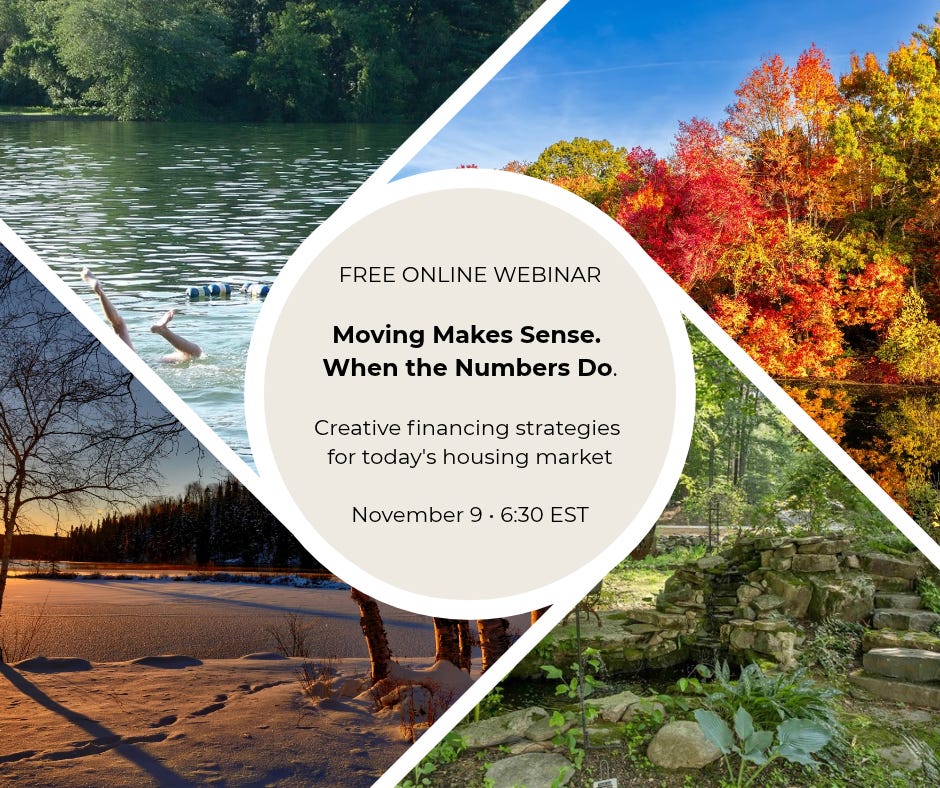
If you’d rather start with a room full of real numbers and different ways to make a move work for you if you’re looking to move, I’m co-hosting a free online session, “Moving Makes Sense. When the Numbers Do.,” with Cindy Veroneau of New American Funding on November 9 at 6:30 PM ET. Register here
Whatever you decide, it’s yours to decide. It’s your house, your numbers, and your timeline, and nobody else can weigh them for you. But please don’t decide in a vacuum. Talk it through with someone you know, trust, and like, whether that’s a sibling, a longtime neighbor, or the friend who will ask the annoying question. Maybe that’s me, and maybe it isn’t. Either way, I’d rather you had someone in your corner than that you sst alone with the spreadsheet or the newspaper.
Here’s to taking a breath first. 🧭
Jenn
Keys to the Lakes
