

Recently I wrote about the restaurants worth driving to up here. This is the piece underneath that one. Because before any of those kitchens plate anything, someone grew it, raised it, or picked it. I wish I could say that means most restaurants up here are sourcing from the farmers and producers listed below. Some are. But I also see plenty of U.S. Foods trucks and Sodexo pulling into parking lots while I’m out and about. So if you care, ask.
Or do what I do, and gradually shift who’s filling your pantry. I have the blackest of black thumbs. Give me a succulent that requires only benign neglect and it will have gone on to that rock garden in the sky in no time. So instead I rely on friends, neighbors, and my local farmers.
There’s a reason this feels worth writing about right now. Cyclospora has been in the headlines this summer, with case numbers running well above a typical season, and one major outbreak traced to bagged lettuce served at a chain restaurant across five states. Up here, where you can get great seasonal produce and humanely raised, humanely butchered meat that you pick up in a cooler in the back of your truck, why wouldn’t you?
I say that without romance. Not every farm stand is a postcard. Some are a folding table under a tarp with a coffee can for cash and a sign that says trust is appreciated and enforced by a dog and a webcam we’re watching you on right now. The closeness is real, and it changes how you eat if you let it.
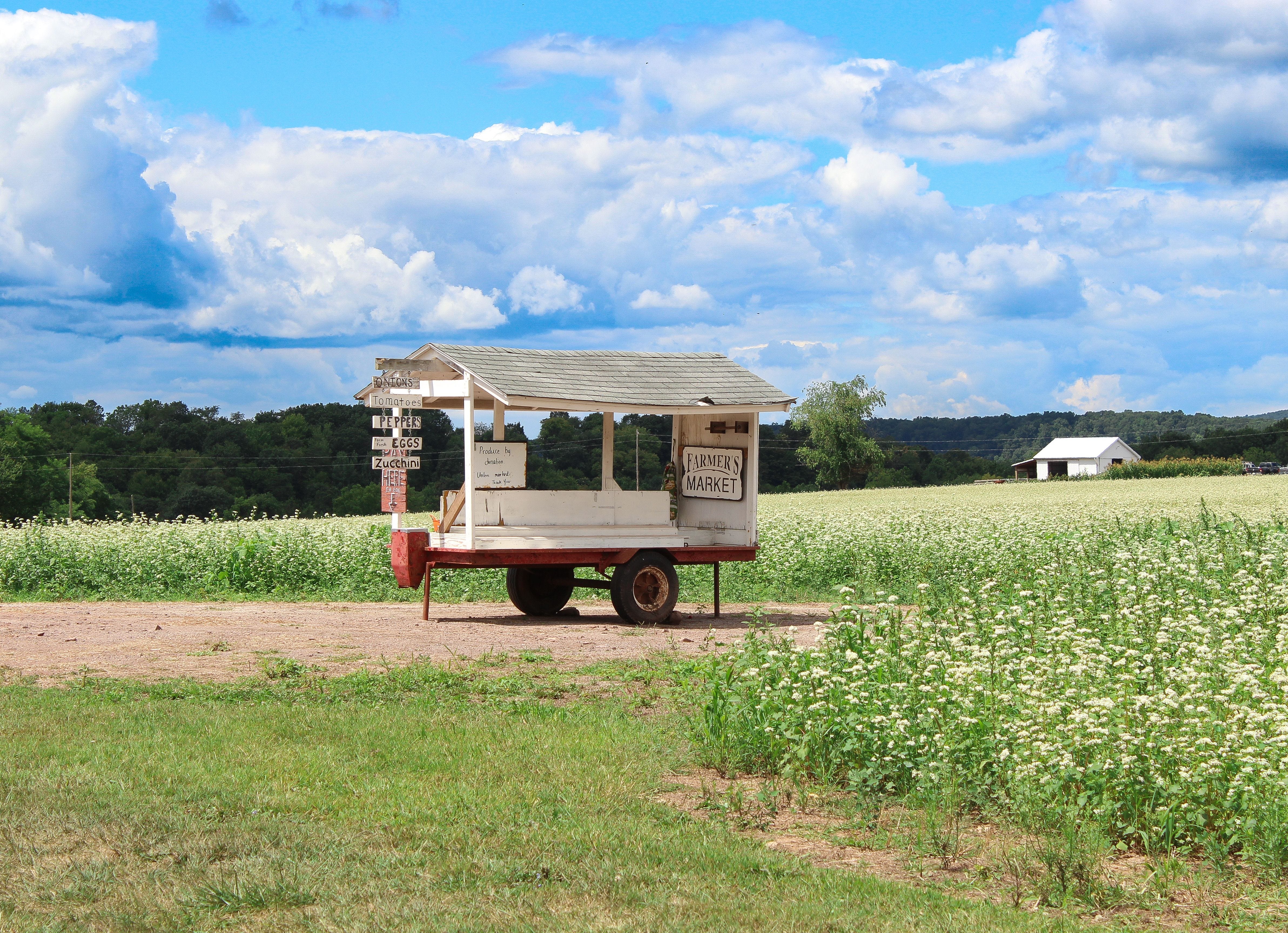
It also means something else. You have choices. So do the people growing your food. Getting to know a grower isn’t about finding the one correct way to farm, it’s about finding people whose choices line up with yours. Maybe that’s certified organic, maybe it’s just organic because that’s how their family has always done it, maybe you care about GMOs, or how animals are raised and processed, or none of that and you just want it to taste like something. None of those positions need defending, at least not to me. But you can’t line up your values with a farm’s if you’ve never asked the farm what its values are. A five minute conversation at a stand tells you more than any label will.
Which is also why a couple of very popular places locally didn’t make this list. I love a good banana. I have real feelings about a ripe mango. But if a Lakes Region farmstand is selling them at retail volume, I want to see the greenhouse that’s supposedly growing them at that scale, because otherwise that’s not local food, that’s a regular grocery run with better lighting.
The Variety You’ll Find is Impressive
I’m going to start with Wakefield Marketplace, running Saturdays from Memorial Day through Columbus Day at the corner of Route 16 and Wakefield Road. It’s been going since 1995, which in market years makes it practically an elder. It’s the kind of market where you’ll run into three people you know before you’ve bought anything. If you’re trying to replace a full grocery run, you probably won’t find everything you need, there are more broadly stocked farmers markets. But if you want to pick up some lettuce, a dozen eggs, and a hat knit by a woman who cards and spins her own yarn or a handmade cutting board and the wood butter to keep it beautiful, this is your place. Find Cythina, the market coordinator and check out her unique and handmade art!
Picnic Rock Farms in Meredith runs fresh fruit and vegetables, a bakery, honey, cut flowers, and a CSA, and I still think about a cheese I bought there last summer. I was taste testing for Lakes and Peaks Provisions and these curds were the perfect blend of salty and creamy, with just a little bite. Now I buy them on my way to showings and eat them before I get home.
Beans & Greens in Gilford has changed shape a few times. It started as a produce farm, and in 2024 it shifted toward partnering with local growers and makers rather than growing everything itself, so what you’re getting now is more curated marketplace than single farm. The bakery, deli, and CSA (they call it Healthy Harvest) are still there, along with a biergarten that’s become its own destination. Worth knowing before you go in expecting the old version. And if you have kids, this place is worth a stop in the fall when they have a ton of traditional New England activities like pumpkin patches, bouncy houses, corn mazes, and more.
Surowiec Farm in Sanbornton has been in the same family since 1917, started as a dairy and poultry operation, and has been diversifying ever since. Apples, blueberries, cut flowers, meat, and a smoked cheese I keep hearing about from other people, if not yet myself. A hundred years of figuring out what actually grows here. That's something you can trust.
If You Want a Regular Commitment that Supports Your Local Food Ecosystem
If you want to actually commit to a farm for a season or more, this is where to look.
Pork Hill Farm in Ossipee is certified organic and grows vegetables, herbs, and cut flowers. They don’t raise pigs (I don’t think). It’s named for the road. Their CSA runs from June through January, including a joint winter share with three other regional farms. And, they do a breakfast spread with a view you won’t believe. Go give them a visit, its worth getting up early for.
Branch Hill Farm in Milton Mills offers naturally grown produce, hay, maple syrup, cider apples, and a CSA of its own. It’s a smaller operation, which tends to mean you know exactly whose hands touched what you’re eating. They also have a great youth internship program, helping inspire and train the next generation of gardeners and farmers, and they have a community run chicken cooperative that shares the labor and costs of an egg flock and divides the eggs amongst themselves.
Mountain Heartbeet in Tamworth is a woman-owned certified organic farm with an eighteen-week CSA and pick-your-own red raspberries in July. You’ll also find them at the Wolfeboro and Tamworth farmers markets if a full share feels like more than you need.
For meat specifically, Top of the Hill Farm in Wolfeboro sells grass-fed beef by the piece, quarter, half, or whole. If you’ve never bought meat that way, it’s a different kind of commitment than a grocery store cooler, and most people who do it once don’t go back. Or if you just ask around, I bet your neighbors can tell you who is fattening a few pigs over the summer and might be willing to sell you a share for your freezer. Bartering is real, too, I recently traded a couple of meat chickens and 18 eggs for some venison. I don’t hunt, but I make a mean hunter’s stew and this fall, I’ll be grateful my neighbor knows what he’s doing so I can gross the kids out by making vension stew for dinner.
The Broader Local Ecosystem of Goods
Moose Mountain Farm in Brookfield is a small family dairy selling raw milk from Jersey and Guernsey cross cows, along with yogurt and butter. It’s the kind of place where the milk tastes like a different food than what comes in a carton. And, if you’re in the neighborhood, you might as well stop by Frost Heave Brewery where a couple turned their garage into a micro-brewery.
Main Street Maple in Belmont makes maple syrup and honey, with apiaries scattered around the Lakes Region. Good gift territory, and a good excuse to visit a sugarhouse if you never have.
The Empty Nest Blueberries & More in Brookfield is a small pick-your-own operation, the kind of afternoon that costs almost nothing and takes longer than you plan for, which is exactly the point.
My neigbor Caitlin and I have been raising and selling our own chickens for meat this year, which has taught me more about patience, the true cost of producing high quality local food humanely, and logistics than I expected. Our next batch will be ready in September or so, so message me if you want to reserve a few. I also usually have eggs on hand, and so do most of my neighbors. If you’re driving through and see a cooler with a sign and a cash box, that’s the whole system. Take what you’re paying for and don’t be one of the tourists whose faces end up on the town facebook page as someone who “forgot” to leave money.
The Olde Ways at Mustard Seed Farm in Tuftonboro hand makes herbal salves, creams, and teas on a working farm, and has been building out classes alongside a small farm store. If you want to learn something instead of just buying something, this is where I’d point you.
Tiny Hill Farm in Milton Mills raises Nigerian dwarf dairy goats, plus a flock of rainbow egg-laying chickens, and runs goat classes if you want to learn the animal before you commit to the milk. Goat's milk products aren't for everyone, but if you've never had fresh goat cheese from a farm five minutes from your own, it's worth the detour to find out which camp you're in.
Pride & Breadjudice bakes artisan sourdough out of Ossipee, small batch, organic when they can manage it. If you've been buying sandwich bread at the grocery store out of habit rather than choice, this is the easiest way to break that habit. And it is a truth universally acknowledged that fresh sourdough with butter beats most gentlemen as a breakfast companion, whatever their income.
A closing thought
None of this is necessarily as easy or efficient as driving 25 minutes to the supermarket and loading up once a week. A CSA means committing to a season before you know what it holds. A meat share means freezer space and trust that processing was done cleanly and kindly. An honor-system cooler means someone left their morning's work unlocked on the side of the road and trusted it would be there at the end of the day.
But that’s also the whole appeal. You end up knowing where your food came from, sometimes literally which field, which is worth something anytime and worth quite a lot in a summer when the news can’t say the same about a bag of lettuce.
If you want to send someone a piece of this place, Lakes & Peaks Provisions was built for that kind of gesture. And if you have a favorite grower, maker, or farmer, share it with the rest of us in the comments!
🧭 Jenn
Keys to the Lakes
