

One of the things about buying and selling real estate is that a lot of the process is repeated across transactions. Listing. Offers. Inspections. Closings. But some parts deserve a lot more intentionality than they sometimes get. Take selling a house. There’s an approach that is pretty typical. A photographer with a drone comes out on a Tuesday. The listing that talks about the “blend of modern updates and timeless character” or “clean lines and ample space to spread out” goes live Thursday. You hodl an open house Sunday, two to four. Maybe there’s wine or coffee and cookies. The, the wait for an offer begins. Do another open house every weekend until you get one. If no offers come in for a month, talk to the seller about dropping the price. Repeat the same four steps for the next house, and the one after that.
It’s not wrong, exactly. It just treats the house like a product that is interchangeable with a lot of other products, not a place, or a lifestyle, that can be felt — and I think that gap is where a lot of good properties get sold short.
As always, I want to be transparent with you. In my second year of real estate practice, I mostly work with buyers, and I love it. I bought my own home in my mid-forties — later than most, if only by a few years according to the most recent NAR data. And here’s what I learned while house hunting for myself: every house and every seller has a story they could tell about that house. When I visited a cape in Warner, the listing agent talked about the appliances, the new tile job, the storage in the basement. But what made me think about putting in an offer was a story I built in my head about having coffee at a little table in the back yard listening to the birds and how I would make the pub down the street my go-to hang out when I wanted a drink and some conversation with other adults. How I could have the serenity of the woods, but be at my nieces for bubbles in the backyard and storytime before bed in under an hour. Did the details matter? Of course they did, but what sells a house, in my opinion is a story.
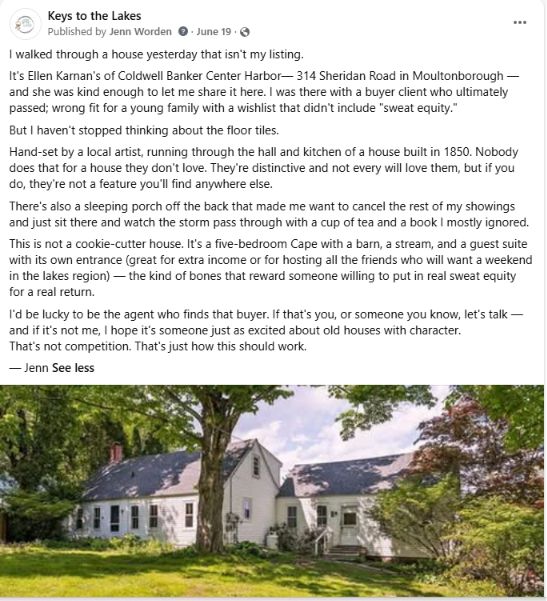
So, I thought I would share how I market properties to buyers. Not just when they’re my own listing, though definitely then. If you follow Keys to the Lakes on facebook (and if you don’t, come find me!), you’ll probably have noticed that I’ve started sharing select properties there that aren’t my listings. I always get permission from the listing agent to do so and credit them in the post (because: transparency and community over competition please). Its often a house I’ve popped into during an Open House, or I’ve shown to a client who has decided its not quite right for them. But the house, like many houses, spoke to me; it whispered that it had a hundred different stories to tell. So, when that happens, I pick the one that leaps into my imagnation and share it.
Here’s my general approach to marketing a house, whether you’re listing with me or you’re an agent who has given me permission to boost your listing with potential buyers on the hunt.
Recently, I met with a couple who spends a few months a year, spread across summer and fall, living in a cottage in the woods about 15 minutes from Lake Winnipeesaukee. They’re thinking about selling. Not because they have to. Because it’s time, in the way these things become time, slowly and then all at once. And when we talked about what mattered to them beyond the number, they didn’t lead with square footage or the roof’s age. They led with the way afternoon light comes through the trees and lands on the porch around four. They told me about guests who’ve stayed there over the years, people who arrived wound tight from wherever they’d come from and left three days later looser, slower, quieter in a good way. That’s not a detail for them. That’s the whole point of the place. Somewhat sheepishly, as though I wouldn’t take them seriously, they told me that the land the house is on just carries some energy that is welcoming and calming. I didn’t scoff, I nodded knowingly. I could feel it too.
If I were to market that cottage like an investment property, I would have failed them before even starting. If I were to lean into short-term rental potential because the numbers would support it, I would have told a true story that isn’t their story. Their cottage could make someone money. That was never the question they were asking me to answer. And, they’re still thinking about whether they’re ready to let this one go, which is absolutely fine.
Once you start thinking about marketing as storytelling, it starts with figuring out which story is not only true, but also resonant. Not the story that sells fastest, unless that’s the sellers express need. The one that’s going to speak to someone out there looking for just the thing that the seller also loves about the home. For the cottage, that would have meant photography and video built around stillness and light, not staged perfection. It would have meant a virtual open house so a family in Connecticut who can’t get up here on a random Wednesday can still feel what the porch feels like at four o’clock and ask questions about what’s in that cabinet as though they were beside you.
For properties where a physical open house makes sense, I’ll host one and I’ll give it my all. But an open house is one tool, not the whole toolbox, and I’m not going to hand a seller a single tool and call it a strategy. A strategy might mean assisted showings when a property benefits from someone walking a buyer through the parts that don’t photograph. The particular quiet of a place. The sound the dock makes. Things a listing sheet can’t hold. It always means social media that treats the property as a place, not a product. The difference matters more than you might think, and is rare enough that when I talk about it this way people sometimes raise their eyebrows.
And it means pricing as a conversation, not a formula I base on comparable properities and interest rates. I’ll totally look at those and bring a range of what I think the market will support in this moment. But comps alone can’t tell you what this specific property, with this specific light and this specific history, is worth to the right buyer. I’ll bring the data. I’ll also bring judgment, and I’ll expect you to push back on both.
None of this means I can guarantee who ends up owning the cottage, or what they’ll do with it once the sale closes. I can’t promise the next owner will feel what my sellers feel when they’re sitting on that porch. Nobody can promise that. What I can do is market the property so it reaches the kind of person who’s looking for exactly what it offers, instead of burying that in generic language built for a buyer who wants something else entirely. I can tell the true story carefully enough that someone recognizes it. What they build from there is theirs.
That’s the job, as I see it. Not put it up and wait. Understand what’s actually being sold, tell that story with everything available to me, and trust that honesty reaches the person who’s meant to find it.
🧭 Jenn
Keys to the Lakes
