You’re probably on a group text.
It could be with your siblings if you have them. Or with friends in the same stage of life as you.
Maybe it started with something one of you noticed over the holidays — a parent on the ladder again, or the way hosting seemed to take more out of them than it used to. Maybe it was a doctor’s appointment that surfaced something nobody was quite ready to talk about.
Maybe it’s been building quietly for a couple of years, and the thread is just where it lives now: unanswered between the day-to-day pings and memes you all share.
You know something needs to happen. You’re just not sure what. Or how. Or when. And if there are siblings involved, you may not even agree on that much.

This is the conversation a lot of families are in the middle of right now — not the conversation with their parents, but the one among themselves. The one about how to even begin. And, there are no easy answers.
We work with families in this exact moment all the time. One of the things we’ve come to deeply understand is that the hardest part isn’t the real estate. It’s figuring out how to help someone you love through a transition they didn’t ask for, without making them feel like the decision has already been made for them.
That line — between helping and taking over — is thinner than most people expect. Like razor thin.
What “support” actually means
Here’s what we see most often: adult children who are genuinely trying to do the right thing, and parents who feel like they’re being managed. Both things can be true at once. Nobody is the villain. But the dynamic is real, and it’s worth understanding where it comes from.
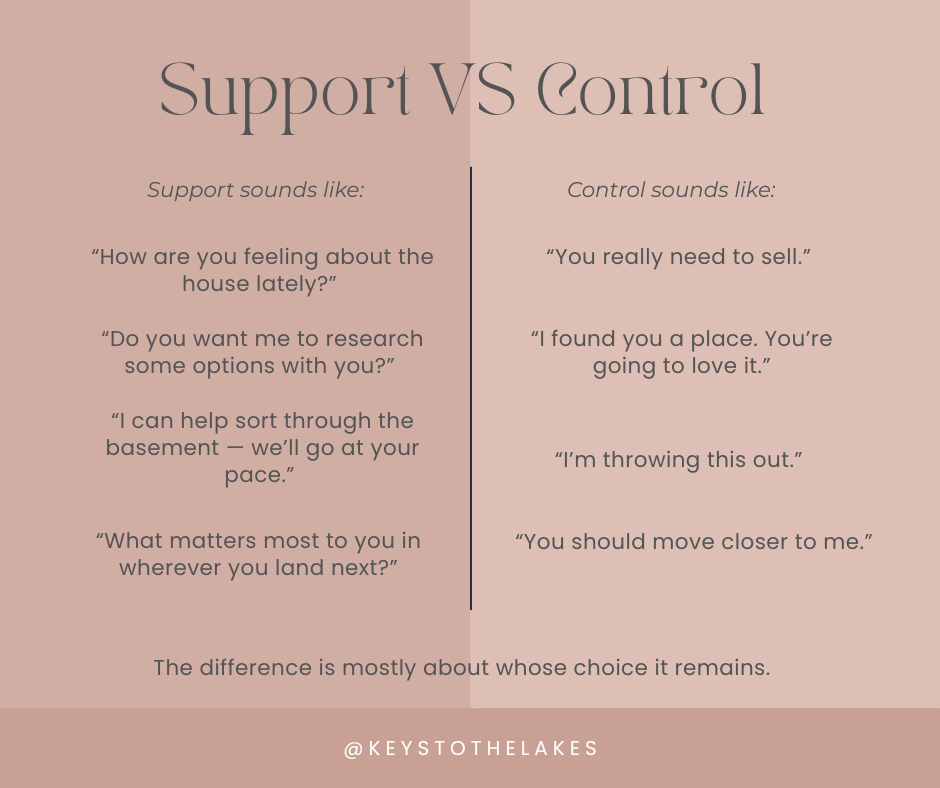
The difference between support and control usually comes down to one question: who does this decision ultimately belong to?
Support says: I see you’re carrying something heavy. I want to help you figure it out. Control says: I’ve already figured it out. I need you to get on board.
It’s rarely that blunt. More often it sounds like: “I found you a place.” Or “I already called an attorney.” Or “We really think you should sell before summer.” Said with love. Said with fear. Said from genuine concern. But landing, on the receiving end, as pressure.
We’ve seen it go the other direction, too — adult children so careful not to push that they don’t help at all. They hold their worry quietly, drop a hint, back off at the first sign of resistance, and wonder later why nothing moved. That’s not support either. That’s avoidance with good intentions.
Real support lives somewhere in the middle. It takes initiative without taking over. It opens doors without walking through them first.
Starting the conversation
The first conversation is not the decision conversation. This is worth saying from your chest: the first conversation is not the decision conversation.
If you sit down to “talk about downsizing” and you already know what the outcome will be, your parent will sense it. And they will resist — not because they’re being difficult, but because something that belongs to them is being handled without them.
A better opening is just curiosity. Genuine curiosity, not pretend curiosity to seem open.
How are you feeling about the house lately? Is there anything that’s felt harder this winter? Have you thought at all about what the next chapter might look like?
And then — this is the part most people skip — listen to the answer. Really listen. Without redirecting. Without pivoting to “well that’s exactly why we think...” Just listen.
It sounds simple. It is not simple. Especially when you’re worried. Especially when you’ve been thinking about this for months. Especially when a sibling is texting you in real time about what your parent just said at dinner.
But the families who navigate this well almost always describe the same thing on the other side: a parent who felt heard before they felt helped.
The part nobody talks about
Here’s something we, individually and culturally, don’t say enough: this is hard for you, too. Not just logistically. Emotionally.
You are watching someone you love become more fragile. You are watching a house that has held your family — or sits on the lake you’ve returned to for thirty summers — start to feel like a burden instead of a given. You may be doing all of this while raising your own kids, managing your own work, and navigating siblings you love but don’t always agree with.
You’re allowed to grieve this.
The parent’s grief gets most of the airtime in these conversations — and rightfully so. We’ve written about it before. But the adult child’s grief is real, too, and it often goes completely unnamed. The loss of the house isn’t only theirs. The childhood bedroom, the dock, the way the kitchen smells in December — those things belong to you as well. And letting go of them is its own kind of loss.
If you can name that — even just quietly, even just to yourself — it tends to soften the places where families get rigid with each other. The impatience when things move slowly. The frustration when a parent won’t “just decide.” The friction between siblings about whether to wait or push.
Usually underneath those is grief, not stubbornness. And grief needs a little room before it can become a plan.
The people who can help
You don’t have to carry all of this alone, and you probably shouldn’t try.
There are professionals work together in a team to support the full arc of the transition. A Senior Move Manager can help coordinate the physical logistics of a move, assist with sorting a lifetime of belongings, and take real weight off the family. Estate sale companies can handle the disposition of things with care and efficiency, so you’re not making a thousand small decisions in a single weekend. Elder law attorneys can make sure the legal and financial pieces are in order before the property conversation even begins — wills, trusts, property transfers, Medicaid planning, and all the complexity that comes with NH real estate, especially if there are multiple properties or family camps involved.
We work within teams like this. Our role is the property — what it’s worth, what’s realistic in this market, what the timeline might look like given where your family actually is. But we’re not the only piece of this, and we know it.
If you’re not sure where to start, start with a conversation. We can help you figure out what kind of support the situation calls for first, and point you toward the right people. No agenda, no timeline we’re pushing.
What “ready” actually looks like
People ask us sometimes: how do we know when it’s the right time?
Honestly? You don’t always. You make the best decision you can with what you know, at the pace the person you love can actually move. And you trust that going carefully is not the same as going wrong.
The families who come through this well aren’t the ones who made the fastest decision. They’re the ones who made it together. Who asked the right questions before they scheduled the appointments. Who brought in help where help was needed. Who gave grief a little room before they gave it a deadline.
If you’re at that kitchen table right now — worried, uncertain, maybe halfway through a long thread with your sister — you’re not behind. You’re right where most people are when this begins.
Here’s to the conversations that take longer than we expect, and go better than we feared.
🏔️ Jenn & Andrea
Keys to the Lakes