

It’s been a week since our last post—we took a little breather to recharge, and now we’re roaring into fall ready to go. We hope you’re also taking whatever time you need to rest and recharge. As we refocus for fall, we’re hearing more and more from folks who want the best of both worlds—time at the lake, and income from renting when they can’t be here.🍂
So, if you’re dreaming of days on the lake or slopes and evenings listening to loons or sitting by the fire you’re not alone. Short-term rentals (STRs) can ease the cost of ownership with rental income, making a property work double-duty:
✅ You enjoy the home when you want.
✅ It helps cover costs when you don’t.
✅ The property stays lived-in, not sitting empty.
But there are challenges too: septic and safety codes limit capacity, HOAs sometimes have stricter rules than towns, and regulations shift as communities balance tourism with neighborhood peace.
Think of this as your plain-English 2025 snapshot for how this works in a selection of towns where buyers are often thinking about short term rentals as income generation. Always confirm locally before you buy, because rules can and do change with Town Meeting votes or Selectboard decisions.
First, the Statewide Layer (New Hampshire)
Meals & Rooms (Rentals) Tax = 8.5%. If you rent for fewer than 185 nights to the same guest, you must collect and remit this tax.
That means registering for a DRA Meals & Rooms Operators License. Platforms (Airbnb, VRBO) may help with collection, but the license and filings are still your responsibility.
More info: NH Revenue Administration.
Town-by-Town Snapshot
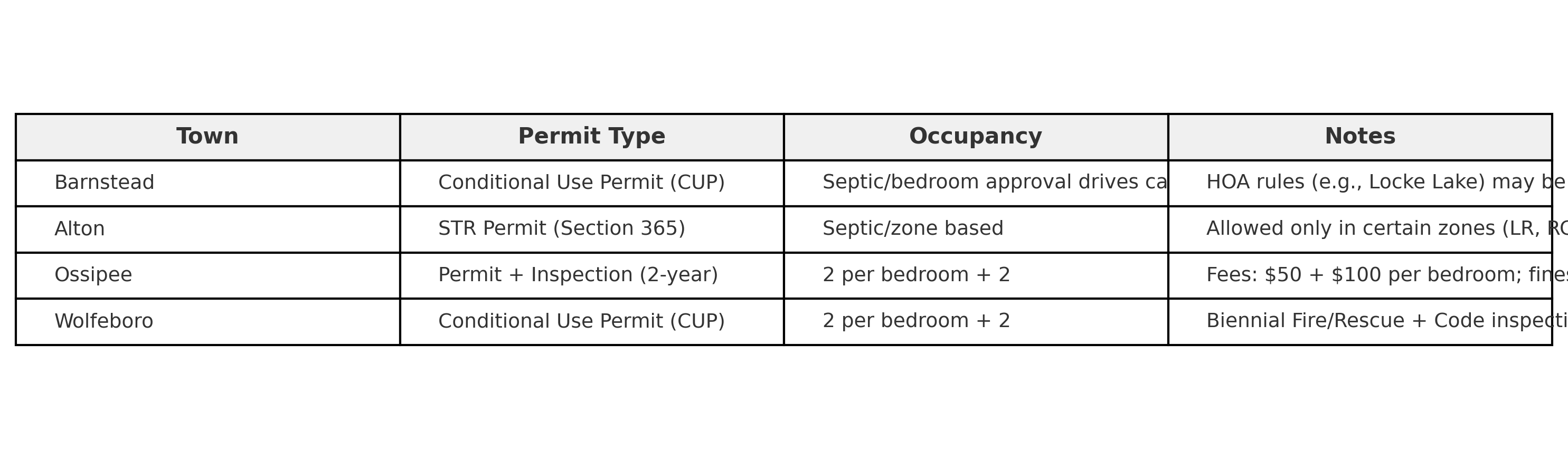
Barnstead (Locke Lake & Suncook Lakes)
Rule: Allowed with a Conditional Use Permit (CUP) from the Planning Board.
What to watch:
Budget time for the CUP process.
Confirm septic bedroom count vs. advertised occupancy.
Check HOA bylaws if you’re in Locke Lake—guest passes, amenity use, and boat rules can be stricter than town ordinances.
Alton (Alton Bay & Mount Major side of Winnipesaukee)
Rule: STR Permit required. Governed by Section 365 of the zoning ordinance.
What to watch:
Rules cover septic, water, parking, safety.
STRs permitted in certain zones (LR, RC, RR, RU, RS).
Always ask: Which zone is this property in? Then pull Section 365 + permit history before making an offer.
Ossipee (Ossipee Lake & Villages)
Rule: Permit + safety inspection required (valid for 2 years).
Occupancy: 2 guests per bedroom + 2 more for the property.
Fees: $50 + $100 per bedroom for a 2-year permit.
What to watch:
On-site parking required.
Special events not allowed.
Violations can mean fines up to $1,000/day or permit revocation.
Do the septic/bedroom math carefully—capacity drives legal occupancy.
Wolfeboro (“The Oldest Summer Resort in America”)
Rule: Allowed by CUP in all zoning districts.
Inspections: Biennial Fire/Rescue + Code review.
Occupancy: 2 per bedroom + 2 total.
What to watch:
Proof of your NH Meals & Rooms license required.
Historic homes or quirky layouts may need upgrades (egress windows, detectors) to comply.
Buying Strategy We Recommend (So You’re “Permit-Ready” on Day 1)
Confirm use before you offer. Have your agent pull the current ordinance + zoning and double-check with the Code Office.
Septic & bedrooms rule everything. Approved septic capacity = legal occupancy. Verify with NHDES.
Safety checklist early. Knock out detectors, extinguishers, egress, and parking plans during inspection, not after closing.
HOA reality check. Association bylaws can override town rules—don’t promise lake toys before you confirm.
Taxes & filings. Get your Meals & Rooms Operators License and filing system in place even if the platform collects tax.
But Even If You Can Rent, Should You?
Just because it’s allowed doesn’t mean it’s always the right move. Short-term rentals can be a powerful tool for making ownership more affordable, but they come with tradeoffs. Here are a few things to weigh before you hand over the keys, whether you’re renting to strangers or to friends and family:
👍 Benefits
Offset costs. Rental income can help cover mortgage, taxes, and upkeep—turning your second home into a self-supporting asset.
Flexibility. You decide when to rent and when to reserve time for yourself, adjusting season by season.
Market demand. Lakes Region properties—especially lakefront, lake access, ski mountain adjacent, or in-town homes—see strong rental interest year round.
Asset appreciation. Even while it’s generating income, your property can grow in long-term value.
👎 Drawbacks
Wear and tear. Guests don’t treat your home with the same care you would. Expect higher cleaning, maintenance, and replacement costs.
Management load. Even with a property manager or platform, you’re on the hook for guest questions, turnovers, and compliance.
Personal availability. The more you rent, the less spontaneous access you have for family weekends or last-minute getaways.
Community concerns. Neighbors may be less thrilled about rotating guests, and some towns adjust rules in response to complaints.
Bottom line: STRs can be a great way to make the math work—but they’re not a free lunch. Be honest about how much time you’ll actually spend here, your tolerance for extra logistics, and how you want your Lakes Region home to feel when you walk in the door.
And, a final hedge from us, because we always want to be responsible about the guidance we’re sharing. Rules for STRs in the Lakes Region are living documents—adjusted as towns balance visitor demand with neighborhood character.
Use this guide to set expectations, but always call the town office before you buy or list.
And if you want a sanity check? We’re happy to walk through the latest rules with you and map a step-by-step path from offer to “guest-ready.”
