

It starts subtly enough that you almost miss it.
Not silence breaking, exactly. More like texture returning. For months, the morning soundtrack has been reliable: the pair of crows Jenn’s been feeding all winter, doing their rounds, making their opinions known. A hawk circling overhead. That’s it. That’s the whole show.
But sometime in the last week or two, something shifted. Just after dawn, before the day gets going, there’s been something else. Varied birdsong. Multiple voices, layered, not yet the full-throated deafening chorus that will eventually start waking Andrea through her open window (she leaves it open year-round; really), but there. Present. Building toward something.
And then there are the flashes.
We’ve been catching them from our home offices, mid-sentence in an agreement or mid-scroll through deed research. A burst of bright red. The chatter of a full bush full of chickadees. Gone before you can fully register it, but real enough that you look up. Real enough that you notice the afternoon has shifted somehow, that something outside has woken up without any dramatic announcements.
The birds know something. You won’t convince us they don’t. They don’t wait for the calendar or the forecast. They read signals we may feel deep inside, but have lost touch with, and they move on them. If they’re saying spring is coming early, we’re inclined to believe them.
Here in the Lakes Region, we’ve learned to pay attention.
The Ones Who Stayed
Before we talk about who’s coming back, it’s worth a moment for the ones who never left.
The black-capped chickadee has been with us all winter. Small, round, seemingly unbothered by temperatures that sent the rest of us indoors grumbling. Chickadees are regulars at feeders from November through March, and their fee-bee whistle, two clear descending notes, is often the first birdsong you hear shift in late winter. It’s a territorial signal. A small, declarative claim on the warming air.
The white-breasted nuthatch has been here too. You’ve probably seen one, running headfirst down the trunk of a white pine like gravity is optional. Nuthatches spend winter caching food in bark crevices, and they’ll be back at your suet feeder until the insects return. Watch for the rust-colored flanks and the sharp, nasal yank yank call. They’re easy to overlook, but once you know what you’re hearing, you’ll notice them constantly.
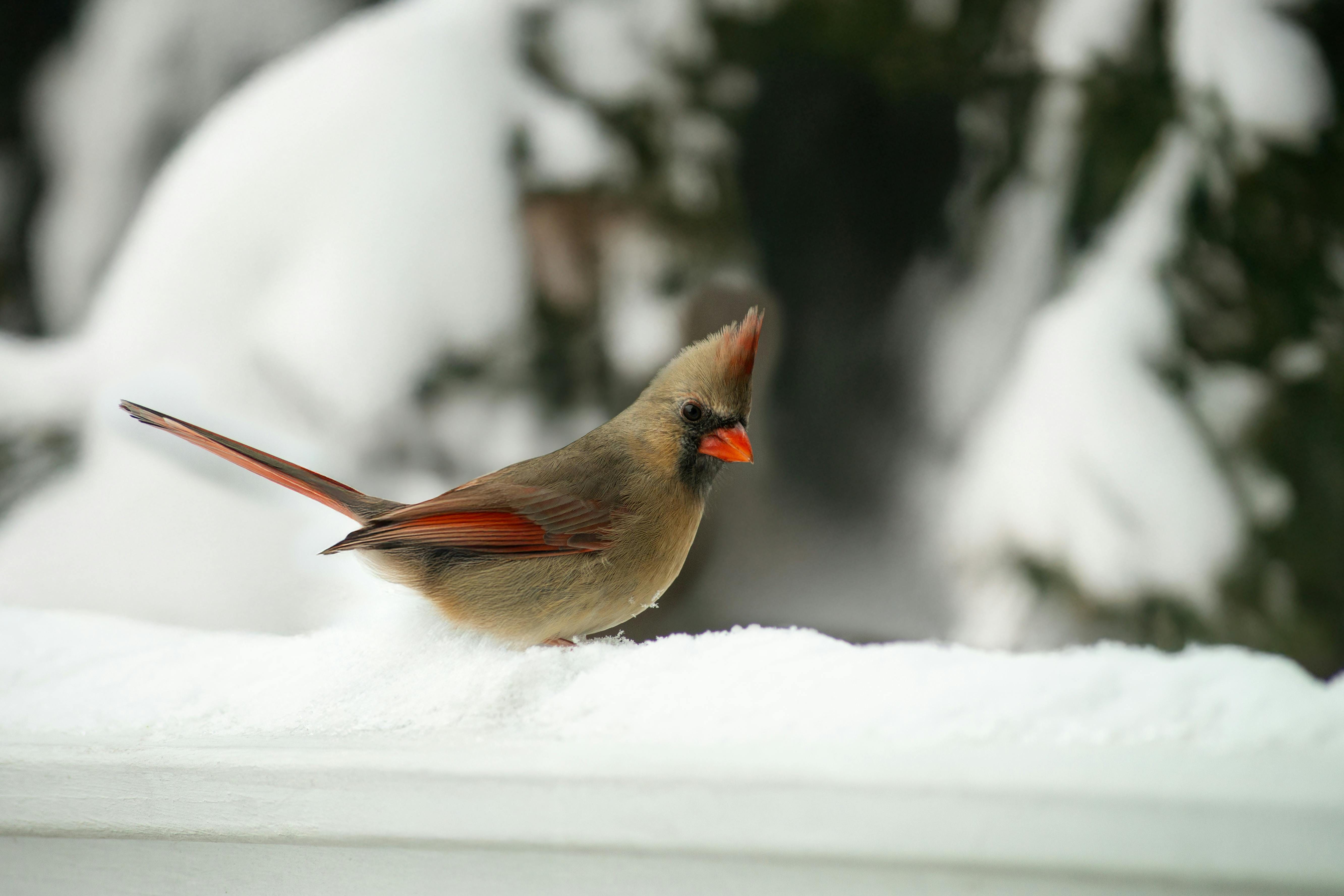
And then there's the northern cardinal, which is Jenn's particular favorite. The male is almost unreasonably beautiful. That specific shade of red, not orange-red, not brick, but a deep, declarative crimson that looks almost impossible against a grey March sky or a snow-covered feeder. He doesn't sneak up on you. He arrives. The female is subtler, a warm tawny brown with red-flushed wings and crest, and once you start looking for her you'll find she's often nearby, less visible but no less present. Cardinals are year-round residents here; they haven't gone anywhere. But something about early spring light makes them seem newly vivid, like the season turned up a dial. Keep sunflower seeds in your feeder and they'll come reliably. They tend to feed low, close to the ground, unhurried. Worth stopping whatever you're doing to watch.
These three are your baseline. They’ve been holding the territory all season. What’s coming next is the return of everyone who left.
The Reliable Ones: Robins
The American robin is the bird most people mean when they say “spring is here.”
They’re not wrong, exactly, but robins are more complicated than the greeting-card version. Some robins overwinter in New Hampshire, moving through in loose flocks, eating berries in the woods rather than worms in your lawn. The robins you’ll see in March aren’t necessarily the same ones who disappeared in October. But their arrival on patches where the snow has disappeared, their distinctive orange-red breast, their liquid, caroling song at dusk, these things mark the moment reliably enough.
Robins are ground foragers. They’ll follow the frost line, appearing on south-facing slopes and open lawns as the soil softens. If you see them working the grass outside your window, your lawn is thawing. That’s not a metaphor. It’s a data point.
Listen for them at dawn and dusk. Their song is one of the more beautiful sounds a March evening offers, long, musical phrases with a feeling of conversation between notes. Once you know it, you’ll hear it in your sleep.
The Loud Arrival: Red-Winged Blackbirds
There is nothing quiet about a red-winged blackbird.
The males arrive first, usually in late February or early March, before the females, before the bugs, sometimes while there’s still ice on the wetland edges. They perch high on cattails or fence posts and conk-la-ree, that three-syllable, slightly raspy song that carries across open water in a way that feels too loud for the season. They are declaring territory. Loudly. Relentlessly. Against all competitors and sometimes, seemingly, against the landscape itself.
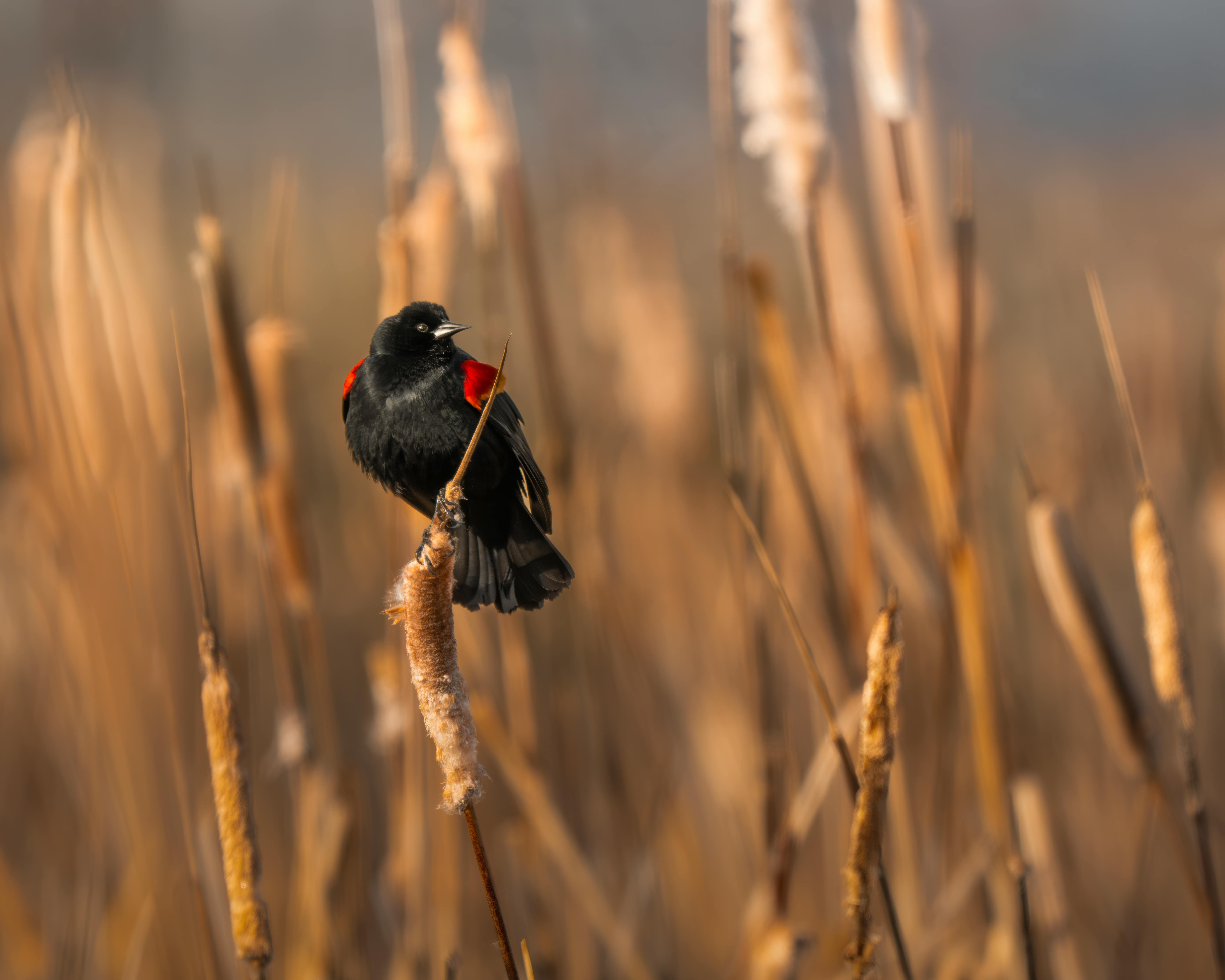
Watch for the scarlet and yellow shoulder patches on the males. In flight, they flash against their black bodies like something tropical borrowed briefly for the season. Females are brown and streaky, easy to miss, but worth finding.
Red-winged blackbirds tell you the wetlands are waking. If you’re near a marsh, a beaver pond, the edge of a lake, and you hear that call, the season has shifted. Something is moving underneath the surface of everything.
The Careful Ones: Bluebirds
Eastern bluebirds require a different kind of attention.
They’re not loud. They don’t announce themselves. The male’s blue is extraordinary, a deep, almost iridescent sky-blue on the back and wings, rust-orange on the breast, but you can miss one if you’re not looking. They tend to perch on fence lines, on the edges of open meadows and fields, scanning the ground below. They hunt from above: a small hover, a drop, a return to the perch. Patient and precise.
Bluebirds are cavity nesters, which means they depend on existing holes in trees or, increasingly, nest boxes. Old-growth snags and woodpecker cavities are harder to find than they used to be. That’s where we come in.
If you have an open yard, a meadow edge, or a field, putting up a bluebird box is one of the most direct things you can do to help them. Placement matters. The box should face open ground, be mounted on a smooth pole (to discourage predators), and be positioned away from heavy tree cover. The opening should be 1.5 inches in diameter, which admits bluebirds but is too small for starlings.
The New Hampshire Audubon Society is an excellent resource for box specifications, local monitoring programs, and placement advice. If you want to host bluebirds, it’s worth doing it right. They’ll reward the effort.
A Rough Timeline: When to Expect Them
Migration isn’t a precise science, and the Lakes Region’s latitude and terrain make local variation real. That said, here’s a general framework for what March and April look like, bird by bird.
Red-winged blackbirds typically arrive in the last week of February through mid-March. They’ll be at the wetland edges first.
Robins appear on lawns in March, though they may have been in the woods all along. Full lawn presence usually tracks with soil thaw.
Eastern bluebirds return in March, often overlapping with the last cold snaps. They’re hardy, but they do need insects or berries to survive late freezes.
Tree swallows come later, typically late March through April. Their arrival tracks the insect hatch on ponds and lakes. If you see tree swallows skimming the water, the lakes are warming.
By May, the full chorus is back. Warblers, flycatchers, orioles, the whole season-long negotiation of territory and nesting begins in earnest.
But March is where it starts. In the quiet between one world and the next.
What This Has to Do With Living Here
We talk sometimes about how the Lakes Region teaches you to read the land. Not in any mystical way, though that’s cool, too. In a practical, embodied way. The ice going out of Winnipesaukee is a marker. The sap buckets on the maples are a marker. The red-winged blackbird calling from the cattails at the edge of a pond is a marker.
These things don’t tell you what to feel. They just tell you where you are.
If you’re new here, or thinking about being here, this is part of what the seasons offer. A kind of literacy that builds slowly. You can’t rush it. But once you have it, it’s yours.
Here’s to the first bird you hear that makes you stop what you’re doing and listen.
🐦Jenn & Andrea, Keys to the Lakes
